Why Your Coffee Shop Habits Could Put Patient Information at Risk
Why Your Coffee Shop Habits Could Put Patient Information at Risk
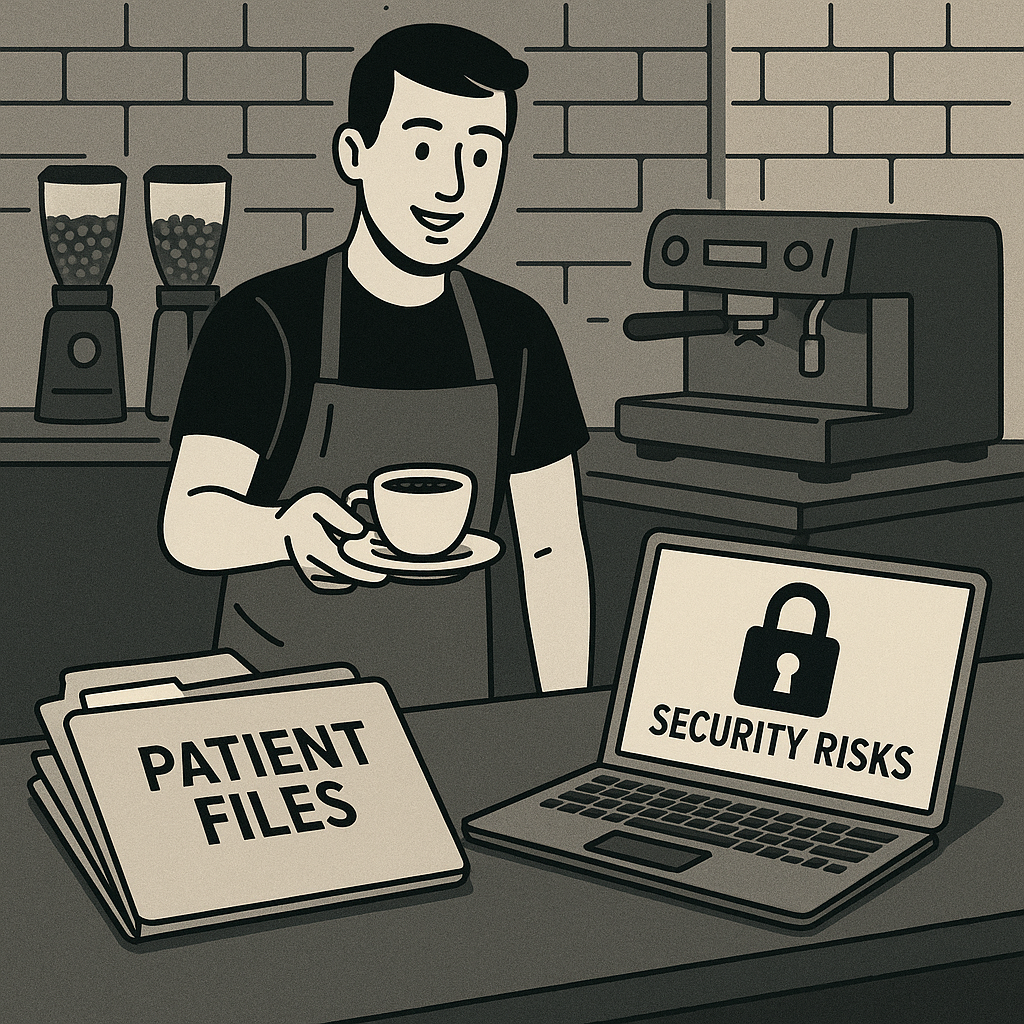
The Starbucks cup with a misspelled name has become a social media punchline. But in healthcare, that same moment of distraction represents something far more serious: an opportunity for sensitive information to be exposed. When healthcare workers review patient files in public spaces, discuss cases within earshot of strangers, or leave devices unlocked on shared tables, they create risk that goes well beyond inconvenience.
Public spaces present unique challenges for healthcare professionals who work remotely or handle sensitive information outside traditional clinical settings. The HIPAA Security Rule requires covered entities to implement safeguards that protect electronic protected health information, including administrative, physical, and technical controls. Many of these requirements extend to behavior in public environments, even though the coffee shop itself is not a covered entity.
This is not about fearmongering or suggesting that remote work is inherently dangerous. Rather, it addresses a practical reality: healthcare professionals increasingly work in settings that were never designed with patient privacy in mind, and many have not received clear guidance about how everyday habits can create compliance gaps or security incidents.
Understanding Protected Health Information in Public Settings
Protected health information encompasses far more than medical records stored in electronic health record systems. Under HIPAA, PHI includes any individually identifiable health information that relates to past, present, or future physical or mental health, the provision of healthcare, or payment for healthcare. This definition extends to conversations, notes, emails, text messages, and any other format where health information and identifying details appear together.
The challenge in public spaces is that PHI exposure can occur through multiple channels simultaneously. A healthcare worker reviewing patient charts on a laptop screen creates visual exposure. A phone conversation about a patient creates auditory exposure. Even a text message notification previewed on a locked screen can reveal information if the message content includes identifiable details.
The key distinction is between incidental disclosure and disclosure that results from inadequate safeguards. HIPAA recognizes that some incidental disclosures are unavoidable even when reasonable safeguards are in place. However, working in a crowded café without privacy screens, discussing patient details by name in public, or leaving devices unlocked and unattended goes beyond incidental risk and enters the territory of inadequate safeguards.
How Visual Access Creates Risk
Shoulder surfing remains one of the most underestimated threats in public spaces. This technique requires no technical skill—just proximity and observation. A person sitting nearby can read emails, view patient charts, see billing information, or capture screenshots with their own phone, all without ever touching the target device.
Healthcare organizations address this risk through multiple layers. Privacy screens reduce the viewing angle of laptop and tablet displays, making it difficult for anyone not directly in front of the screen to see content. Training programs teach staff to position themselves with their backs to walls, minimize time spent on sensitive tasks in public, and use screen timeouts that lock devices after brief periods of inactivity.
But technology and positioning only go so far. The fundamental issue is environmental awareness. Many people work in public spaces with the same level of focus they would bring to a private office, without scanning their surroundings or considering who might be watching. This creates a cognitive disconnect where the work feels private even though the setting is not.
Real-world examples illustrate why this matters. Hospital employees have been disciplined for reviewing patient records in airport terminals. Billing staff have been terminated for discussing account details in coffee shops. Medical assistants have had phones stolen from tables with patient information still displayed on unlocked screens. These incidents result from routine behavior in environments that do not support that behavior safely.
When Conversations Become Compliance Issues
Overheard conversations represent a particularly difficult challenge because they feel ephemeral. Unlike a laptop screen that can be photographed or a device that can be stolen, a conversation seems to vanish once it ends. But people remember what they hear, especially when it involves recognizable names, dramatic medical situations, or details that could be monetized.
The cases mentioned in healthcare fraud prosecutions often begin with overheard information. Personal injury lawyers have been convicted of paying hospital staff for information about car accident victims. The initial connection frequently starts with a conversation in a public place where someone realizes they have access to valuable information and begins to consider how that access could be monetized.
HIPAA does not prohibit all discussion of patient care outside clinical settings. Healthcare professionals need to consult with colleagues, discuss cases with supervisors, and coordinate care with other providers. The distinction is whether the conversation includes individually identifiable information and whether reasonable precautions are in place to prevent unauthorized access.
Reasonable precautions in public settings include speaking quietly, avoiding patient names and other identifiers, moving to private areas for sensitive discussions, and being aware of who is nearby. Many healthcare organizations train staff to use medical record numbers or initials rather than full names when discussions must occur outside secure environments, though even this carries risk if other identifying details are included.
The practical guidance is straightforward: if a conversation would not be appropriate with the door open in a clinical setting, it is not appropriate in a coffee shop. If information could be used to identify a specific patient, the conversation should wait until privacy can be ensured.
Mobile Device Habits That Create Exposure
Smartphones have become essential tools for healthcare coordination. But the same device that enables rapid communication also creates multiple points of exposure. Text messages containing patient information, emails with attachments, calendar entries with patient names, and even notification previews can reveal PHI when devices are visible in public spaces.
The HIPAA Security Rule requires that covered entities implement policies and procedures to restrict access to electronic protected health information. For mobile devices, this translates to requiring strong passwords or biometric authentication, enabling automatic screen locks, encrypting data at rest and in transit, and using secure messaging platforms rather than standard SMS for any communication containing PHI.
Yet enforcement depends on behavior, not just policy. A device with all the required technical controls still creates risk if left unlocked on a table while the user steps away to order coffee, placed face-up with notifications visible to anyone walking past, or used to discuss patient details in a video call within earshot of others.
Device theft in public spaces is common, and healthcare devices are particularly attractive targets because of their potential to contain valuable information. Medical identity theft has become a significant criminal enterprise, with stolen patient information used to submit fraudulent insurance claims, obtain prescription medications for resale, or create fake identities for other purposes. A single unlocked phone left unattended can provide access to thousands of patient records if the device is used to access electronic health record systems.
The most effective approach combines technical controls with behavioral discipline. Devices should require authentication to unlock, automatically lock after short periods of inactivity, and use full-disk encryption. Users should keep devices in direct physical control at all times in public settings, avoid accessing patient information unless necessary, and immediately report any device loss or theft.
Why Remote Work Requires Different Protocols
The shift to remote work has expanded the environments where healthcare business is conducted. Employees who previously worked only in clinical settings or dedicated offices now handle patient information from homes, cars, temporary workspaces, and while traveling. This geographic distribution creates challenges for organizations trying to maintain consistent security controls.
Many healthcare organizations now require remote workers to use virtual private networks when accessing organizational systems from outside networks, restrict the use of personal devices for work purposes, and prohibit the storage of patient information on devices that are not organization-owned and encrypted. These policies reflect the understanding that home and public networks do not provide the same level of security as healthcare organization networks.
The challenge is that policies can become barriers to productivity if they are too restrictive or poorly explained. Workers who do not understand why a policy exists are more likely to find workarounds that preserve productivity but undermine security. This is why effective security programs combine technical controls with clear explanations of risk and practical guidance for safe practices.
Public Wi-Fi networks present specific risks that many users do not fully understand. When a device connects to an open wireless network, all traffic between that device and the network can potentially be intercepted by others on the same network. While modern encryption protocols protect many types of communication, not all applications and websites implement encryption correctly, and users do not always verify that encryption is active.
Healthcare workers should avoid accessing patient information over public Wi-Fi unless they are using a VPN that encrypts all traffic between their device and the organization’s network. Even with a VPN, visual exposure remains a risk, so combining network security with physical precautions becomes essential.
Building Awareness Without Creating Paralysis
The goal of addressing these risks is not to make healthcare professionals afraid to work outside traditional settings. Remote work offers significant benefits for work-life balance, productivity, and access to talent. Rather, the goal is to build awareness of specific behaviors that create disproportionate risk and to provide practical alternatives that maintain both productivity and security.
Healthcare organizations that successfully manage public-space risk typically focus on scenario-based training rather than abstract policy review. Training that walks through realistic situations—working in a coffee shop, taking a call in a car, reviewing patient information while traveling—helps staff recognize risk in context and develop practical habits that reduce exposure without requiring constant vigilance.
Key protective habits include:
- Using privacy screens on all devices when working in public
- Positioning devices so screens face away from traffic areas
- Using headphones for any calls involving patient information
- Avoiding patient names and identifiers in public conversations
- Keeping devices in direct physical control at all times
- Accessing patient information only when necessary in public settings
- Using VPNs when connecting to non-organizational networks
- Enabling automatic screen locks with short timeout periods
- Being aware of surroundings before accessing sensitive information
- Moving to private areas for conversations that cannot wait
These habits become more effective when they are reinforced through organizational culture rather than enforced through punishment. When healthcare workers understand that the goal is protecting patients and the organization rather than catching mistakes, they are more likely to report close calls, ask questions about uncertain situations, and adapt their behavior based on risk awareness.
Connecting Daily Behavior to HIPAA Compliance
HIPAA compliance is often presented as a set of technical requirements and documentation obligations. But the Security Rule’s emphasis on administrative safeguards includes workforce training, security awareness programs, and the implementation of policies that govern behavior. Public-space awareness is a practical application of these administrative requirements.
Organizations demonstrate compliance not by preventing all possible exposure but by implementing reasonable safeguards and responding appropriately when incidents occur. This means conducting risk assessments that include remote work environments, developing policies that address public-space risks, training staff on those policies, and investigating incidents to determine whether safeguards were adequate.
The individual professional’s responsibility is to understand organizational policies, follow required procedures, and exercise judgment in situations where policies may not provide specific guidance. This includes recognizing when a public environment is too high-risk for certain activities, choosing to delay work until privacy can be ensured, and reporting situations where policy requirements and practical work demands conflict.
What This Means for Early Career Healthcare Professionals
For students and early career professionals entering healthcare, understanding public-space risk is part of developing professional judgment. The coffee shop is not inherently dangerous, but it is also not a clinical environment. Learning to distinguish between settings, activities, and risk levels is a core professional skill that extends well beyond HIPAA compliance.
Career development in healthcare increasingly includes roles that are not location-dependent. Telehealth positions, health information management roles, medical billing and coding jobs, and healthcare IT positions often involve remote work. Understanding how to work safely in non-traditional environments becomes a professional competency that affects both individual career trajectory and organizational risk.
The practical takeaway is straightforward: develop habits early that will serve throughout a career. Use privacy screens as standard practice. Treat patient information as if every conversation is overheard and every screen is visible. Understand organizational policies before they become problems. And recognize that professional reputation is built not just on clinical or technical skill but on consistent judgment about when and where to conduct sensitive work.
Public spaces will continue to be part of modern work environments. The question is not whether healthcare professionals will work in coffee shops, but whether they will do so in ways that protect patient information and organizational compliance. The answer depends on awareness, training, and the daily habits that turn abstract security requirements into practical behavior.
Enjoyed this article?
Subscribe to Professor Simon's weekly newsletter for practical insights, career guidance, and leadership lessons delivered every Friday.
A confirmation email will be sent. If you don't receive it, please check your spam or junk folder.
No spam. Unsubscribe anytime.
Prefer to Listen?
Listen to Professor Simon’s IT & Cybersecurity Podcast for practical conversations about cybersecurity careers, certifications, security leadership, and real-world lessons from the field.
Listen on Spotify