Degree, Bootcamp, or Self-Taught: The Best Path Into Cybersecurity?
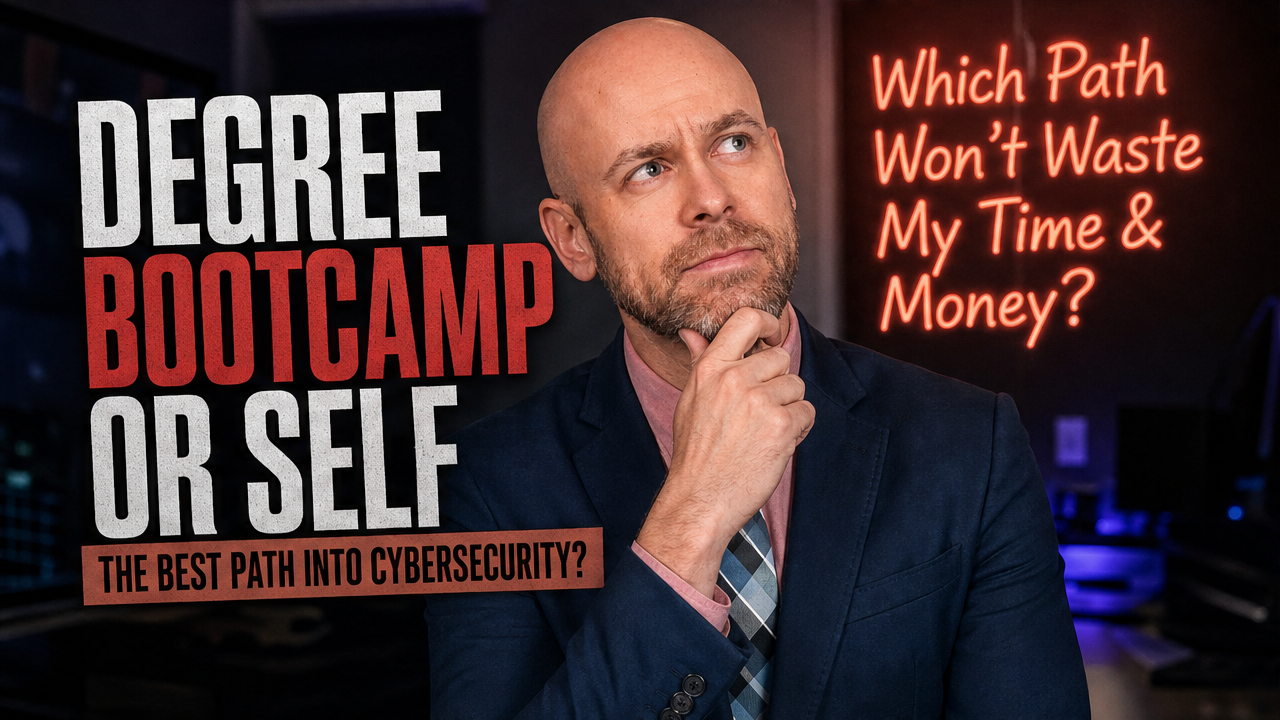
This is probably the single most common question I get from people considering a move into cybersecurity, and it’s usually asked with an undertone of anxiety, like there’s one correct answer they’re afraid of getting wrong. There isn’t a single correct answer. There’s a correct answer for your specific situation, and figuring that out requires being honest about time, money, and how you actually learn, not just which path sounds most credible.
Let’s walk through all three, with real numbers and real tradeoffs.
Prefer to read the full breakdown? Keep scrolling. Prefer to watch? Full video above.
Four-Year Degree
Cost: Wildly variable, but realistically anywhere from twenty thousand to well over a hundred thousand dollars depending on the school.
Time: Four years, sometimes longer.
What it actually gets you: Breadth. A real degree program covers networking fundamentals, systems, sometimes programming, and general education that broadens how you think, not just what you memorize. It also still functions as a hard filter at some employers, particularly larger, more traditional organizations and government-adjacent roles, where a degree requirement isn’t negotiable regardless of how good your practical skills are.
Where it falls short: Depth in current, practical security skills. A lot of degree programs are still catching up to industry pace, and you can graduate with a strong theoretical foundation and almost no hands-on experience with the tools you’ll actually use day one.
Bootcamp
Cost: Typically five thousand to twenty thousand dollars, occasionally more for specialized programs.
Time: Eight to twenty-four weeks for the intensive version, though many people take longer part-time.
What it actually gets you: Speed and structure. A good bootcamp compresses a lot of practical, hands-on skill building into a short window, with a curriculum somebody else already designed and a cohort to push through it with you. That structure is genuinely valuable if you struggle with self-directed learning.
Where it falls short: Quality varies enormously between programs, and the credential itself carries far less weight than a degree with a lot of employers. You’re really paying for the structure and the accountability, not the piece of paper at the end. If you could replicate that structure yourself for free, you’d be paying purely for convenience.
Self-Teaching
Cost: Can be nearly free, or a few hundred dollars for exam vouchers and lab access, depending on how disciplined you are about not buying every course that looks appealing.
Time: Entirely dependent on you. This is both the appeal and the danger.
What it actually gets you: The cheapest possible path, and often the most practical skill development if you’re disciplined, because you’re forced to build your own home lab, work through real documentation, and problem-solve without someone handing you the answer.
Where it falls short: No external accountability, no structured curriculum unless you build one yourself, and it’s the path most likely to stall out indefinitely without ever converting into an actual job search. I’ve seen more people quietly abandon self-teaching after six months than any other path, not because it doesn’t work, but because nothing forces momentum.
What I’d Actually Recommend
Here’s where I’ll push back on conventional advice: the “best” path isn’t the one with the most credibility. It’s the one you’ll actually finish. A bootcamp is worthless if you drop out at week six. Self-teaching is worthless if it never turns into applying for jobs. A degree is expensive dead weight if you use it as a four-year delay tactic instead of building practical skill alongside it.
If you already have a bachelor’s degree in anything, I’d lean toward a bootcamp or focused self-teaching plus certification, rather than a second degree, because you’ve already cleared the “degree requirement” filter at most employers and now need practical, current skill fast.
If you’re starting from nothing, including no degree, and you have the discipline for it, self-teaching plus one solid certification plus a documented home lab project is the cheapest real path in, but only if you’re honest with yourself about whether you’ll actually stay consistent without external structure.
My Take
I’d rather see someone finish a mediocre bootcamp and land an entry-level role than spend three years perfecting a self-taught path that never quite feels ready to apply. Momentum matters more than pedigree at the entry level. Pick the path that matches how you actually work, not the one that sounds most impressive at a dinner party, and commit to finishing it.
Tagged:
Enjoyed this article?
Subscribe to Professor Simon's weekly newsletter for practical insights, career guidance, and leadership lessons delivered every Friday.
A confirmation email will be sent. If you don't receive it, please check your spam or junk folder.
No spam. Unsubscribe anytime.
Prefer to Listen?
Listen to Professor Simon’s IT & Cybersecurity Podcast for practical conversations about cybersecurity careers, certifications, security leadership, and real-world lessons from the field.
Listen on Spotify