Why Small Businesses Are Prime Targets for Cyber Attacks

Why Small Businesses Are Prime Targets for Cyber Attacks
The belief that small businesses are too insignificant for hackers to bother with ranks among the most dangerous misconceptions in cybersecurity. In reality, 43% of all cyberattacks target small and medium-sized businesses, not because they’re overlooked, but because they represent the path of least resistance. Attackers don’t discriminate by company size—they discriminate by vulnerability, and small businesses often present the easiest opportunities.
Supply chain attacks targeting SMBs have increased 400% since 2021, revealing a calculated strategy: hackers use small vendors as entry points to reach larger enterprise targets. This makes even the smallest business with Fortune 500 clients a valuable target. Meanwhile, 60% of small business owners identified cybersecurity as their top concern, yet only 23% feel adequately prepared to defend against attacks. This gap between awareness and action creates the perfect conditions for successful breaches.
Understanding why attackers focus on small businesses—and what makes them vulnerable—provides the foundation for building realistic defenses without enterprise-level budgets.
The Economics of Targeting Small Businesses
Attackers operate with business logic. They calculate return on investment, assess target difficulty, and optimize their efforts for maximum profit with minimum resistance. Small businesses offer attractive economics on all three counts.
The average cost of a data breach for a small business ranges from $120,000 to $1.24 million, representing catastrophic financial damage for organizations operating on tight margins. Attackers know this creates pressure to pay ransoms quickly rather than endure extended downtime. Unlike large enterprises with incident response teams, backup systems, and business continuity plans, small businesses often face an existential choice: pay the ransom or potentially close permanently.
Research shows that 60% of small businesses that experience a major cyber incident shut down within six months. This vulnerability makes them reliable targets—businesses desperate to restore operations tend to pay without negotiation or law enforcement involvement.
The resource gap further tilts economics in the attacker’s favor. Thirty-five percent of small businesses lack dedicated IT security roles, meaning systems go unpatched, configurations remain insecure, and threats go undetected. When a single phishing email can compromise an entire network because no one is monitoring for suspicious activity, the attacker’s effort-to-reward ratio becomes extremely favorable.
Your Data Has More Value Than You Think
The misconception that small businesses lack valuable data fundamentally misunderstands what makes information valuable to criminals. A medical office with 500 patient records, a manufacturing firm with 200 employees, or a retail shop processing 50 credit card transactions daily all hold data worth stealing.
Customer payment information sells reliably on dark web marketplaces. Social Security numbers, healthcare records, and business financial data maintain consistent prices because identity thieves and fraud operators need constant supplies of fresh information. A small accounting firm managing tax documents for 300 clients holds data that could generate six figures in illicit revenue—far exceeding what most small businesses could pay in ransom.
Intellectual property represents another underestimated asset. Small manufacturers, professional services firms, and technology companies develop proprietary processes, client lists, and business strategies that competitors or foreign entities will pay to acquire. A breach doesn’t need to expose millions of records to be profitable; 50 high-value records can provide sufficient return for attackers investing minimal resources.
Business email accounts offer access to financial transactions, vendor relationships, and internal communications that enable business email compromise schemes. These attacks netted cybercriminals over $2.7 billion in 2022, frequently targeting small businesses whose finance teams lack fraud detection training.
Limited Security Infrastructure Creates Opportunities
The security gap between small businesses and enterprises creates a target-rich environment for attackers using automated scanning tools. These tools constantly probe internet-connected systems for known vulnerabilities, unpatched software, default passwords, and misconfigured services.
When scanning identifies a small business running outdated software or using weak authentication, automated exploitation tools can compromise the system without human intervention. The attacker invests minutes of computing time to gain access that might remain undetected for months.
Network segmentation, intrusion detection systems, security information and event management platforms, and dedicated security operations centers remain beyond most small business budgets. Without these layers of defense, a single compromised endpoint can provide access to the entire network. An attacker who phishes one employee’s credentials can often move laterally through systems, accessing financial data, customer information, and administrative controls.
The rise of Ransomware-as-a-Service (RaaS) platforms has industrialized attacks against small businesses. These platforms provide criminal franchises with ready-made malware, payment infrastructure, and technical support, enabling less sophisticated attackers to launch effective campaigns. RaaS grew 60% in 2025, with small businesses representing preferred targets due to their limited defensive capabilities.
The Human Error Factor Overwhelms Technology
Ninety-five percent of successful breaches involve human error, not technology failures. This statistic reveals the fundamental imbalance in how small businesses approach security—investing in antivirus software and firewalls while leaving employees untrained to recognize threats.
Phishing remains the primary attack vector because it works. Attackers use social engineering techniques refined through millions of attempts, testing subject lines, urgency tactics, and impersonation strategies until they identify approaches that consistently fool recipients. With 81% of cybercriminals now using AI tools to craft more convincing phishing messages, the sophistication of these attacks has increased while the cost to launch them has decreased.
A small business might invest $10,000 in a firewall appliance, believing this technology will protect the organization, only to be breached when an employee clicks a malicious link in an email that bypasses the firewall entirely. The weakest link in security is rarely the technology—it’s the person who doesn’t recognize that the “urgent invoice” from a familiar vendor is actually a credential harvesting attempt.
Password practices compound the problem. Employees reusing passwords across personal and business accounts, writing credentials on sticky notes, or sharing login information to simplify collaboration all create entry points that no technology solution can fully address. When one employee’s personal email account is breached due to a weak password, attackers often find that same password works for business systems.
The lack of security awareness training means employees don’t recognize warning signs: unusual sender addresses, unexpected attachments, requests for urgent wire transfers, or links to legitimate-looking but fraudulent websites. These threats require human judgment that technology alone cannot provide.
Supply Chain Vulnerabilities Make Every Connection Count
Small businesses often serve as vendors, contractors, or service providers to larger organizations. These relationships create trust relationships in digital systems—VPN access, shared file repositories, email integrations, or specialized software connections that link the small business to the enterprise network.
Attackers identified this supply chain vulnerability years ago and have systematically exploited it. Rather than attacking the well-defended enterprise directly, they compromise the small vendor with minimal security and use that access as a stepping stone. A small HVAC company with remote network access to monitor building systems, a marketing agency with access to customer databases, or an IT managed service provider with administrative credentials all represent potential pathways to larger targets.
The 400% increase in supply chain attacks since 2021 reflects attackers’ recognition that small businesses provide easier entry points than direct enterprise breaches. When a Fortune 500 company requires vendors to complete security questionnaires, small businesses often view this as bureaucratic overhead rather than recognizing their role in the larger security ecosystem.
This dynamic creates pressure from both directions. Enterprises increasingly require vendors to demonstrate security controls, implement multi-factor authentication, and maintain cyber insurance. Small businesses must meet these requirements to retain contracts, but many lack the expertise to implement controls effectively. This compliance-versus-security gap leaves them vulnerable while appearing to meet requirements.
Inadequate Incident Response Planning Amplifies Damage
The first 24 hours after a security incident determines whether a small business survives. Without preparation, this period becomes chaos: employees unsure how to respond, management uncertain whether to involve law enforcement, IT personnel (if available) scrambling to understand the scope of compromise, and business operations grinding to a halt.
Most small businesses lack incident response plans because they underestimate the likelihood of being targeted. When an attack occurs, this lack of preparation leads to decisions made under extreme pressure, often resulting in ransom payments that could have been avoided with proper backups, or communication mistakes that compound reputational damage.
The absence of tested backup and recovery procedures means ransomware attacks become existential threats rather than recoverable incidents. Backups stored on network-connected drives get encrypted along with production systems. Backup procedures never tested turn out to be incomplete or incompatible with current systems. Recovery time objectives exist only as theoretical concepts rather than measured capabilities.
Small businesses also lack relationships with forensic investigators, legal counsel specializing in breach notification, and public relations professionals who can manage customer communication. Scrambling to assemble this expertise during an active incident wastes critical time and often results in suboptimal outcomes.
The Hybrid Workforce Multiplies Attack Surfaces
The shift to hybrid and remote work models expanded the attack surface for small businesses without corresponding increases in security infrastructure. Seventy-five percent of small businesses with hybrid work arrangements experienced security incidents in the past year, revealing how work-from-anywhere models create new vulnerabilities.
Home networks lack enterprise security controls. Employees connecting to business systems from residential internet providers, using personal devices that also access business data, or working from coffee shops on public WiFi all create exposure points. Without virtual private networks, endpoint detection and response tools, or mobile device management systems, small businesses have limited visibility into where their data resides or how it’s being accessed.
The bring-your-own-device trend compounds these risks. Personal laptops and smartphones used for business purposes often run outdated operating systems, lack security patches, and have consumer-grade antivirus protection. When these devices access business email, cloud storage, or internal applications, they introduce vulnerabilities that the business cannot fully control.
Video conferencing, collaboration platforms, and cloud storage services adopted rapidly during pandemic transitions often receive minimal security configuration. Default settings that prioritize ease of use over security, shared login credentials for team accounts, and unrestricted file sharing capabilities all create opportunities for data exposure or unauthorized access.
IoT Devices Create Unexpected Entry Points
Small businesses increasingly deploy internet-connected devices—security cameras, smart thermostats, point-of-sale systems, printers, and voice-activated assistants—without recognizing these devices as potential attack vectors. These Internet of Things devices often ship with default passwords, receive infrequent security updates, and run embedded operating systems with known vulnerabilities.
Security cameras monitoring a retail store or office provide live video feeds, but they also provide network access if compromised. Attackers can use an insecure camera as a pivot point to scan internal networks, intercept traffic, or launch attacks against other systems. Point-of-sale systems represent particularly valuable targets because they process payment card data, making them ideal for harvesting credentials or installing card skimming malware.
The challenge for small businesses is that IoT security requires expertise most organizations lack. Understanding which ports devices should expose, how to segment IoT devices onto isolated networks, and how to monitor for unusual behavior requires networking knowledge beyond basic business IT skills.
Manufacturers often discontinue security support for IoT devices after two to three years, leaving small businesses operating vulnerable equipment without realizing patches no longer exist. A security camera system installed in 2019 might function perfectly for its intended purpose while simultaneously running firmware with exploitable vulnerabilities.
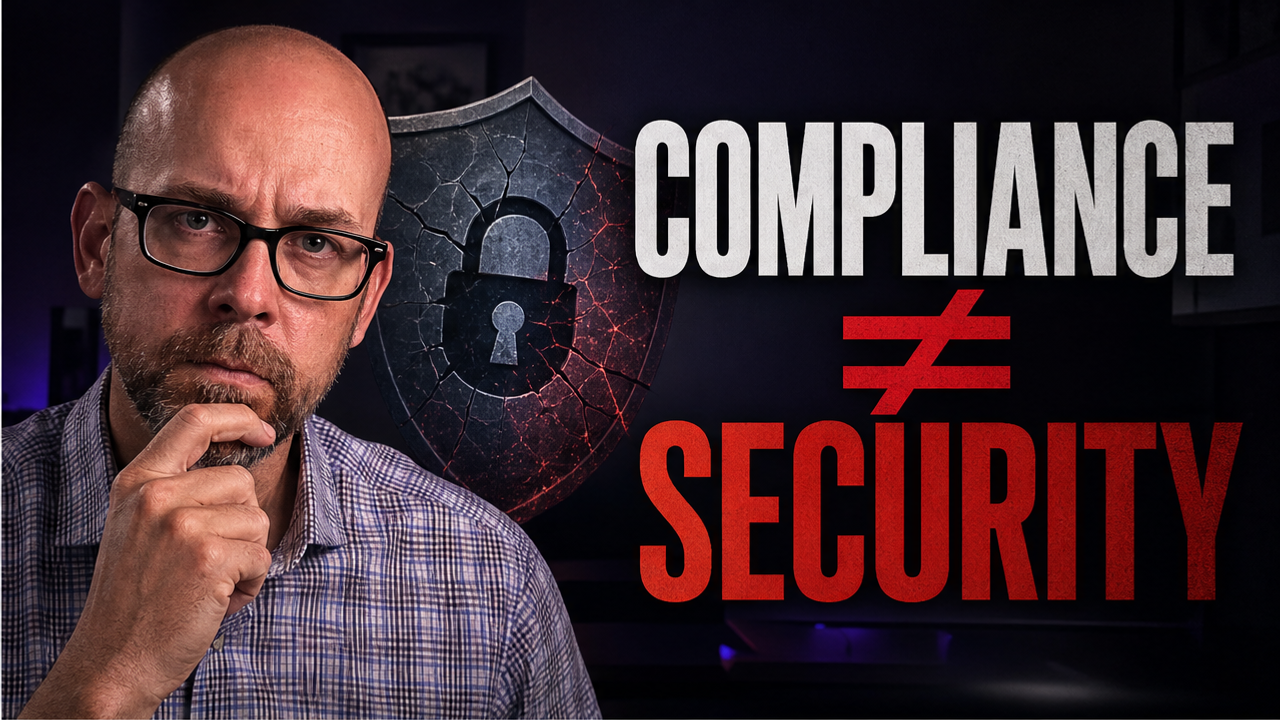
Compliance Does Not Equal Security
Small businesses operating in regulated industries often confuse compliance with security. Achieving PCI-DSS certification for payment card processing, meeting HIPAA requirements for healthcare data, or satisfying state data protection regulations represents important baseline accomplishments, but these frameworks establish minimum requirements, not comprehensive security.
Compliance audits typically assess whether documented policies exist, whether required technologies have been deployed, and whether specific controls can be demonstrated during the audit period. They don’t measure whether security practices actually prevent breaches or whether employees consistently follow procedures between audits.
Businesses with perfect compliance scores still experience breaches because compliance frameworks focus on specific requirements within defined scope, while attackers exploit any vulnerability they can find regardless of regulatory boundaries. An organization compliant with payment card requirements might still be vulnerable to phishing attacks targeting employee email accounts, ransomware exploiting unpatched systems outside the cardholder data environment, or business email compromise schemes that bypass technical controls entirely.
The checkbox mentality around compliance creates false confidence. Meeting requirements becomes a goal rather than a starting point, and security investments focus on audit preparation rather than risk reduction. This approach leaves small businesses technically compliant but practically vulnerable.
Building Practical Defenses on Small Business Budgets
Understanding why small businesses attract attacks provides the foundation for realistic defenses. Protection doesn’t require enterprise budgets or full-time security teams—it requires addressing the specific vulnerabilities attackers exploit most frequently.
Employee training delivers the highest return on investment because human error causes 95% of breaches. Regular security awareness training that teaches employees to recognize phishing attempts, verify unusual requests, use strong unique passwords, and report suspicious activity addresses the primary attack vector. This training needs to be ongoing rather than annual, using realistic simulations that help employees develop instinct for recognizing threats.
Multi-factor authentication (MFA) prevents the majority of credential-based attacks. Even when attackers obtain passwords through phishing or data breaches, MFA blocks unauthorized access. Implementing MFA for email, cloud services, VPN access, and administrative accounts costs little but eliminates attackers’ easiest entry method.
Regular software patching closes known vulnerabilities before attackers exploit them. Automated patch management tools can handle routine updates for operating systems and major applications, while a documented schedule ensures critical systems receive timely security updates. The overwhelming majority of successful exploits target vulnerabilities for which patches have been available for months or years.
Tested backup and recovery procedures transform ransomware from an existential threat to a recoverable incident. Backups stored offline or in immutable cloud storage, tested quarterly through actual restoration exercises, and covering all critical systems provide insurance against both ransomware and hardware failures. The key word is “tested”—untested backups often fail precisely when they’re needed most.
Network segmentation limits how far attackers can move after initial compromise. Separating guest WiFi from business networks, isolating IoT devices, and requiring authentication to access sensitive systems means that compromising one laptop doesn’t provide access to the entire organization. This defense-in-depth approach can be implemented with modest networking equipment and proper configuration.
Moving Beyond the “Too Small to Target” Myth
Small businesses will continue to face disproportionate cyber risk because the fundamental economics favor attackers: high-value data, limited defenses, and pressure to pay ransoms create ideal conditions for profitable attacks. The rise of automated tools, ransomware-as-a-service platforms, and AI-enhanced phishing means the volume and sophistication of attacks will increase.
The “too small to target” myth persists because it’s comfortable to believe. Acknowledging vulnerability requires action, investment, and ongoing attention that many small business owners would prefer to avoid. However, pretending invisibility provides protection has never been an effective security strategy.
Attackers don’t assess targets based on feelings or fairness—they assess based on opportunity and return. Small businesses that implement basic security controls, train employees to recognize threats, and prepare for inevitable incidents transform themselves from easy targets to harder ones. Attackers move on to businesses that remain unprotected.
The question is not whether small businesses will be targeted—they will. The question is whether they’ll be prepared when attacks come, or whether they’ll become another statistic in the 60% of small businesses that close within six months of a major cyber incident.
Security doesn’t require perfection or unlimited budgets. It requires consistent attention to fundamentals, recognition that every business regardless of size holds valuable data, and commitment to protecting customers, employees, and the business itself from preventable harm.
Enjoyed this article?
Subscribe to Professor Simon's weekly newsletter for practical insights, career guidance, and leadership lessons delivered every Friday.
A confirmation email will be sent. If you don't receive it, please check your spam or junk folder.
No spam. Unsubscribe anytime.
Prefer to Listen?
Listen to Professor Simon’s IT & Cybersecurity Podcast for practical conversations about cybersecurity careers, certifications, security leadership, and real-world lessons from the field.
Listen on Spotify