Your Company Accepted the Risk. Who Makes Sure It Doesn’t Stay Accepted Forever?
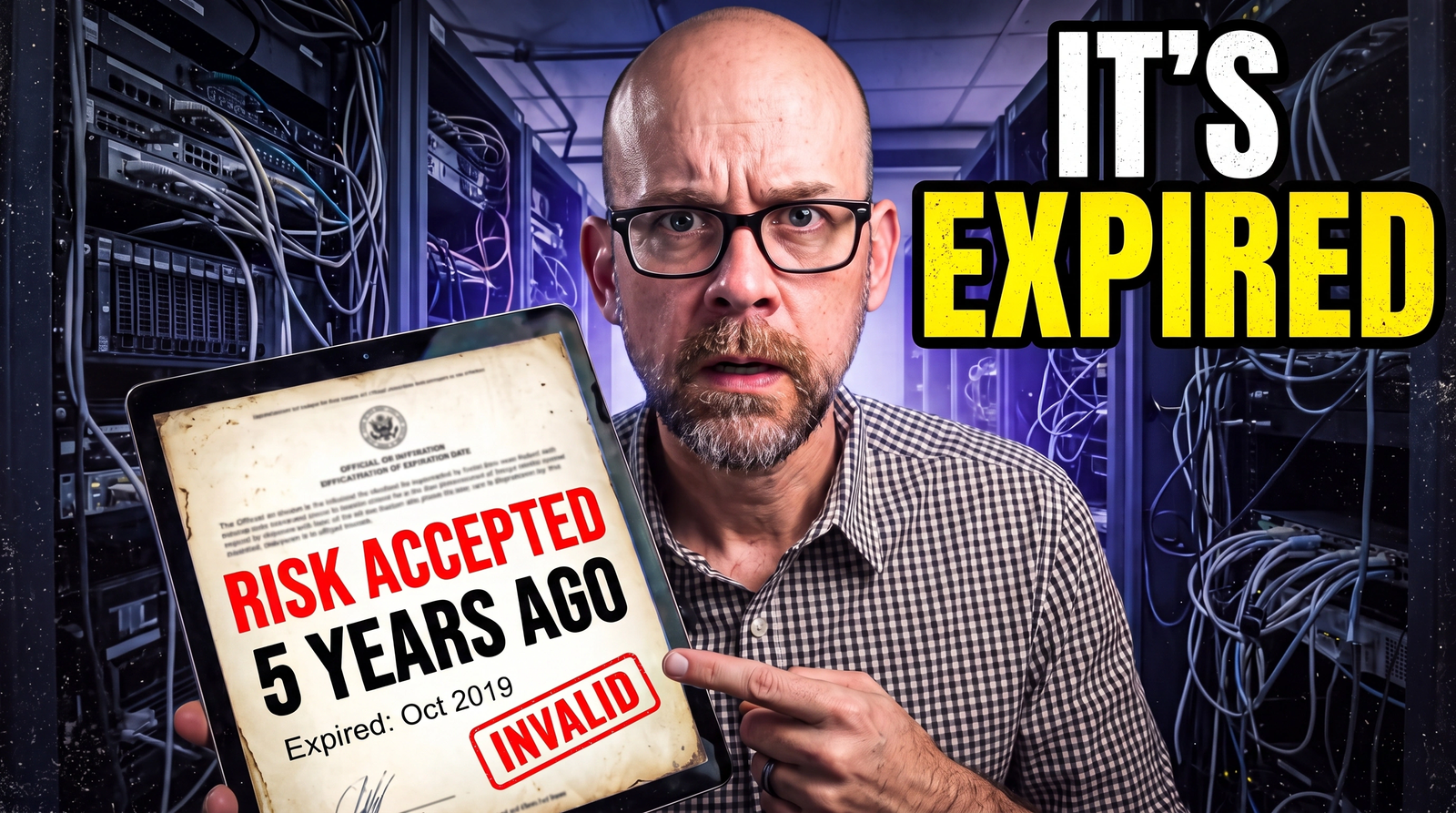
Most organizations have formal processes for accepting cybersecurity risks. Someone identifies a vulnerability or gap. The security team assesses it. Leadership reviews the options. After weighing remediation costs against potential impact, they decide to accept the risk. The decision gets documented. The risk goes into the register. Everyone moves on.
And that’s where the problem starts.
Because in most organizations, that accepted risk will sit in the register for years. The conditions that justified the acceptance will change. The executive who made the decision will move to a different role. The threat landscape will evolve. The compensating controls may degrade or disappear entirely.
But the risk register will show the same thing it showed two years ago: Risk accepted.
Prefer to read the full breakdown? Keep scrolling. Prefer to watch? Full video above.
The Accepted Risk That Never Gets Unaccepted
Risk acceptance creates a strange artifact in organizational memory. It’s treated as a completed transaction, like closing a ticket or finishing a project. Once leadership accepts a risk, it moves from the category of active problems to the category of resolved items.
Except it’s not actually resolved. It’s just acknowledged.
The vulnerability still exists. The gap remains. What changed is that someone made a conscious decision that, given current circumstances, the organization can live with this particular exposure. That decision reflects a specific moment in time, with specific conditions, specific constraints, and specific assumptions about what matters most.
Those conditions don’t stay static. Business priorities shift. Technology changes. Regulations evolve. The competitive landscape transforms. Budget availability fluctuates. Personnel change. Yet the accepted risk notation persists, unchanged, as if the decision exists in a vacuum independent of the world around it.
This matters because your risk register is supposed to reflect your current risk posture. When it’s filled with decisions based on outdated conditions, it becomes less accurate over time. You’re navigating with an old map, and you may not even realize it.
Why Accepted Risks Fade from View
Security teams are busy. There’s always a new vulnerability to assess, a new system to review, a new compliance requirement to address. Attention naturally flows toward new problems that require immediate decisions.
Accepted risks, by contrast, feel settled. Leadership has already weighed in. The documentation exists. No immediate action is required. Psychologically, they shift from active concerns to background context.
This creates an imbalance in how organizations allocate attention. New risks get detailed scrutiny. Recently accepted risks remain fresh in people’s minds. But risks accepted eighteen months ago? Three years ago? They receive almost no attention unless something forces them back into view.
The risk register grows steadily as new acceptances accumulate, but it rarely shrinks. Old entries persist not because someone actively decided they still make sense, but because no process exists to challenge them. The default state is permanence, even though the original decision was based on temporary conditions.
When the Conditions Change But the Acceptance Doesn’t
Consider a common scenario. Your organization accepts the risk of not implementing multi-factor authentication on a legacy system because it’s scheduled for retirement in six months. The decision is reasonable given the circumstances.
Two years later, that system is still running. The retirement project was delayed, then deprioritized, then quietly shelved. Meanwhile, credential theft has become the primary attack vector in your industry. Several competitors have experienced breaches through exactly this type of exposure.
But unless someone actively looks at that accepted risk and questions whether it still makes sense, nothing changes. The risk register still shows the acceptance. New security team members see that notation and assume someone considered it recently. Leadership believes the risk is managed.
Personnel turnover amplifies this problem significantly. The executive who accepted the risk may have moved on. They understood the specific tradeoffs, the timeline expectations, the compensating controls that made acceptance reasonable. That context lived partly in documentation but mostly in their judgment and memory.
New people inherit the decision without inheriting the context. They see that a risk was accepted, but they don’t fully understand why, what assumptions were made, or what conditions were expected to change. They’re often reluctant to challenge a previous executive decision, especially without clear evidence that circumstances have changed.
The practical result is organizational amnesia. Decisions persist after the reasoning behind them has been forgotten.
The Missing Half of Risk Acceptance Governance
Organizations invest significant effort in the front end of risk acceptance. They define approval authorities, specifying which roles can accept which levels of risk. They create documentation templates ensuring that risk decisions are properly recorded. They build workflow systems that route acceptance requests through appropriate reviewers.
This governance is important. It ensures that risk acceptance decisions receive appropriate oversight and consideration.
But it treats risk acceptance as a point-in-time transaction rather than an ongoing responsibility. Few organizations put equivalent effort into defining what happens after acceptance. Who is responsible for monitoring whether the acceptance remains valid? How often should accepted risks be reviewed? What conditions should trigger an early reassessment? When should an acceptance expire if not explicitly renewed?
The result is strong front-end governance with almost no back-end accountability. Organizations know exactly how a risk gets accepted. They have no clear answer for how an acceptance gets revisited, renewed, or retired.
This gap exists partly because it’s harder to build processes for ongoing management than for discrete approvals. A risk acceptance decision is a single event with clear inputs and outputs. Ongoing monitoring requires sustained attention, clear ownership, and mechanisms that work over time despite competing priorities.
It also exists because there’s an implicit assumption that someone will notice if conditions change materially. The assumption is that risk owners, security team members, or business stakeholders will flag when an accepted risk needs review. That annual risk assessments will catch outdated acceptances. That if something important changes, it will naturally surface.
This assumption fails more often than it succeeds. Organizational memory is short. People are busy. Without a forcing function, accepted risks rarely get revisited until something goes wrong.
Building a Sustainable Review Process
The solution is not to eliminate risk acceptance. Organizations need the flexibility to accept risks when remediation isn’t feasible or proportional. The goal is to prevent acceptance from becoming a permanent state by default.
This requires treating risk acceptance as a time-bound commitment rather than an indefinite status.
Implement expiration dates for all risk acceptances. When leadership accepts a risk, that acceptance should be valid for a specific period, typically six months to two years depending on the nature of the risk. After that period, the acceptance expires. The risk must either be remediated, or leadership must explicitly renew the acceptance with current information.
This simple mechanism changes the default state. Instead of acceptances persisting indefinitely unless someone remembers to review them, they automatically require attention on a defined schedule. It forces a deliberate decision rather than passive continuation.
Define specific reassessment triggers. Some conditions should prompt an earlier review even if the expiration date hasn’t arrived. These might include changes in threat intelligence related to that risk category, modifications to the affected system or process, new compliance requirements, departure of the risk owner, or security incidents affecting similar environments elsewhere in your industry.
These triggers don’t need to be exhaustive. The goal is to catch major changes that clearly invalidate the assumptions behind the original acceptance.
Assign clear ownership for monitoring accepted risks. Someone needs explicit responsibility for tracking expiration dates, monitoring for trigger conditions, and initiating the reassessment process. This might be a risk manager, a governance function, or rotating responsibility within the security team.
The key is ensuring this isn’t everyone’s responsibility, which in practice means it’s no one’s responsibility. Make it specific. Put someone’s name on it.
Create a lightweight recurring review process. Perhaps quarterly, the security team and relevant business owners should briefly examine all currently accepted risks. This doesn’t need to be exhaustive re-analysis. It’s a sanity check asking whether anything material has changed and whether any acceptances should be flagged for deeper review.
Keep this process simple enough that it actually happens. An hour-long quarterly meeting is sustainable. A day-long comprehensive review is not.
Include accepted risk metrics in regular reporting. When you report to leadership on security posture, show not just new risk acceptances but also the age distribution of currently accepted risks, upcoming expirations, and any that have been renewed multiple times.
This visibility prevents accepted risks from becoming invisible. It also signals whether the organization is actively managing these risks or passively accumulating them.
What Good Looks Like in Practice
Effective accepted risk management doesn’t require complex systems or dedicated resources. It requires deliberate structure around what happens after the initial acceptance decision.
In mature organizations, when you look at the risk register, you see expiration dates. You see evidence of recent reviews. You see renewals that include updated justifications explaining why the acceptance still makes sense given current conditions.
You also see acceptances that expired and led to action. Either the risk got remediated, or it got escalated because conditions had changed enough that the previous acceptance was no longer appropriate.
The risk register becomes a living document that reflects current decisions about current conditions, not an archive of historical choices that may no longer be relevant.
This doesn’t mean zero accepted risks or constant churn. It means that when a risk is accepted, everyone understands that acceptance is conditional and temporary. It will be revisited. Conditions will be reassessed. The decision will either be renewed with fresh eyes or it will be challenged.
Making This Work in Your Organization
If you’re inheriting a risk register filled with old acceptances, start with visibility. Pull a report showing all currently accepted risks and their original acceptance dates. Look for anything older than two years. Those are your immediate candidates for review.
You don’t need to reassess everything at once. Pick the oldest or highest-impact items and work through them systematically. As you do, document what you find. That documentation builds the case for implementing ongoing review processes.
When you propose adding expiration dates or review triggers to leadership, frame it as improving the accuracy of risk information they rely on for decisions. This isn’t about creating more process. It’s about ensuring that when they look at the risk register, it actually reflects current reality.
Start small if needed. Add expiration dates to new acceptances even if you haven’t tackled the backlog. Implement a quarterly review even if it initially only covers high-impact risks. Build the muscle gradually rather than trying to implement perfect governance all at once.
The goal is sustainable practice, not comprehensive documentation. You want processes light enough that they actually happen, embedded enough that they don’t depend on individual initiative, and valuable enough that people see the point.
The Ongoing Obligation
When your organization accepts a risk, it creates an ongoing obligation to monitor whether that acceptance remains valid. The decision isn’t permanent. The conditions aren’t static. The threats aren’t frozen in time.
Without deliberate mechanisms to revisit accepted risks, your risk register becomes less accurate with each passing month. You lose track of your actual risk posture, operating on assumptions that may no longer reflect reality.
The solution is treating risk acceptance as what it actually is: a time-bound commitment based on current conditions, requiring periodic renewal and active oversight.
This week, pull up your risk register. Look at your accepted risks. Check the dates. Ask yourself honestly: when was the last time someone actually reviewed whether these acceptances still make sense?
If the answer makes you uncomfortable, you’ve just identified where to start.
Tagged:
Enjoyed this article?
Subscribe to Professor Simon's weekly newsletter for practical insights, career guidance, and leadership lessons delivered every Friday.
A confirmation email will be sent. If you don't receive it, please check your spam or junk folder.
No spam. Unsubscribe anytime.
Prefer to Listen?
Listen to Professor Simon’s IT & Cybersecurity Podcast for practical conversations about cybersecurity careers, certifications, security leadership, and real-world lessons from the field.
Listen on Spotify