SOC Analyst Careers: The Complete Guide to Getting Started
The popular image of cybersecurity work involves dramatic scenes of hackers battling in real time, lines of code scrolling across multiple monitors, high-stakes digital warfare. The reality of a Security Operations Center analyst’s day looks quite different, and understanding that difference matters more than almost anything else if you’re deciding whether this role is actually right for you.
SOC analyst positions consistently top the list of recommended entry points into cybersecurity. Job boards overflow with openings, career coaches push the role as accessible, and certification programs market themselves as SOC analyst preparation. What gets lost in that marketing is a clear, honest picture of what the job actually involves day to day, what skills genuinely matter, and how to tell whether it fits how you like to work. This guide covers all of it.
What a Security Operations Center Actually Is
A Security Operations Center is the team, and often the physical or virtual room, responsible for continuously monitoring an organization’s systems for security threats. Think of it as a nerve center: security tools across the organization feed data into it, and the people staffing it watch for signs that something is wrong.
For students, career changers, and early professionals exploring cybersecurity, the SOC offers one of the most accessible entry points into the field, largely because the role is explicitly structured for people building experience rather than people who already have it. That said, “accessible” doesn’t mean simple. It means the learning curve is manageable if you understand what you’re actually walking into.
The Real Day-to-Day, Not the Hollywood Version
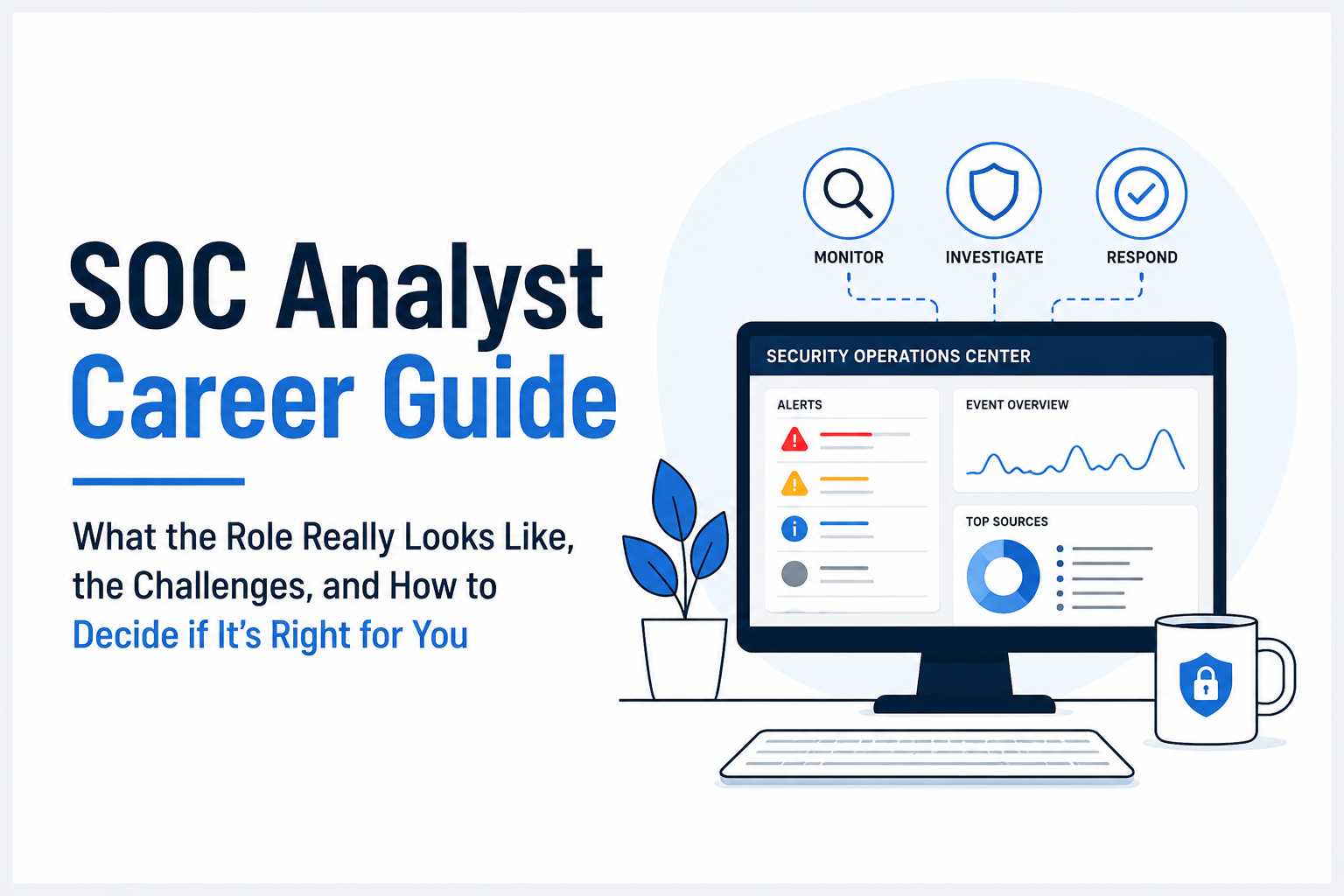
Most SOC analysts spend their time doing something far less cinematic than popular culture suggests: reviewing alerts. A security tool flags something as potentially suspicious, and the analyst’s job is to investigate it and decide whether it’s a genuine threat or a false alarm.
This work follows a consistent daily rhythm. An analyst opens their monitoring dashboard and works through a queue of alerts, prioritized by severity. Each one requires checking the details, cross-referencing other data sources, and making a judgment call: escalate this to a senior analyst or incident response team, or close it out as a false positive. Genuine, active threats are a small fraction of total alert volume; a large share of the job is efficiently ruling things out so the real threats get attention faster.
Beyond alert triage, the role typically includes documenting findings clearly enough that someone else could pick up the investigation, participating in shift handoffs (many SOCs run continuous coverage across multiple shifts), and gradually building the pattern recognition that comes from having seen hundreds of similar alerts before. Entry-level analysts (often called Tier 1) focus heavily on this triage work. More senior analysts (Tier 2 and above) handle escalated incidents, deeper investigation, and eventually threat hunting: proactively searching for signs of compromise rather than waiting for an alert to trigger.
The Problem Nobody Warns You About: Alert Fatigue
One challenge deserves its own explanation, because it shapes the daily reality of the job more than almost anything else: alert fatigue.
Security teams face a mounting volume problem that has nothing to do with sophisticated attackers. Every day, analysts wade through hundreds or thousands of security alerts, trying to separate genuine threats from noise. The overwhelming majority turn out to be false positives: a misconfigured rule, ordinary user behavior that briefly resembled something suspicious, or a tool being overly cautious by design.
The problem compounds over time. When the ratio of false positives to genuine threats stays high for long enough, human attention naturally starts to dull. Alerts blur together. The exact discipline required to catch a real threat, careful attention to detail on every single alert, gets harder to sustain precisely because so few alerts turn out to matter. This isn’t a personal failing; it’s a predictable, well-documented consequence of sustained high-volume monitoring work, and organizations that don’t actively manage it (through better tuning, prioritization, and realistic workload expectations) burn out their analysts faster than the job requires.
Knowing this going in matters for two reasons. First, it’s a realistic expectation to set for yourself: the job involves a lot of “this turned out to be nothing,” and that’s normal, not a sign you’re doing it wrong. Second, when you’re evaluating a SOC role during a job search, it’s worth asking directly how the team manages alert volume and tuning. Teams that take this seriously are generally better places to build a career than ones that don’t.
Is This Role Actually Right for You?
The role’s popularity as an entry point doesn’t mean it’s the right fit for everyone entering cybersecurity. A few honest questions worth asking yourself:
Do you have the patience for repetitive, detail-oriented work? The majority of the job is methodical investigation, not creative problem-solving in the moment. If sustained, careful attention to a high volume of similar tasks sounds tedious rather than satisfying, this role will feel like a grind.
Are you comfortable with shift work? Many SOCs run continuous coverage, which means nights, weekends, or rotating schedules, particularly at the entry level. This is a genuine lifestyle consideration, not a minor detail.
Do you want a clear, structured path to build experience? The SOC analyst role is explicitly designed as an entry point. If you want documented, escalating responsibility and a visible path toward more senior security roles, this structure works in your favor.
Can you handle being wrong most of the time and staying diligent anyway? Given how many alerts turn out to be false positives, maintaining consistent rigor on every single one, including alert number four hundred of the day, is the actual skill being tested. It’s less glamorous than it sounds in a job posting, and that’s worth knowing before you commit to the path.
Skills That Actually Matter
Contrary to popular assumption, most SOC analyst roles don’t require advanced programming skills, expensive certifications, or a computer science degree before you start. What actually matters:
Foundational technical literacy. Understanding how networks work, how operating systems behave, and basic familiarity with common attack types (phishing, malware, credential theft) gives you the context to make sense of what you’re investigating. You don’t need to be an expert; you need enough grounding to recognize when something looks off.
Methodical documentation habits. The ability to write clear, precise notes on what you investigated and why you made a particular call matters enormously, both for handing off work to the next shift and for building a track record that supports your own advancement.
Comfort with tools, not mastery of every tool. SIEM platforms (Security Information and Event Management systems), ticketing systems, and threat intelligence feeds are the daily toolkit. Familiarity with how these tools generally work matters more than deep expertise with any specific vendor’s product, since most organizations will train you on their specific stack.
Genuine curiosity paired with discipline. The analysts who advance fastest are the ones who stay curious about why something happened, even after determining an alert was a false positive, while still maintaining the discipline to move efficiently through the queue rather than getting lost down every rabbit hole.
Getting In: A Realistic Path
Entry-level SOC analyst roles are explicitly structured for people without direct security experience, which means the path in is more accessible than most other cybersecurity specializations.
Build foundational knowledge. A basic understanding of networking and security fundamentals, whether through a certification like CompTIA Security+, self-study, or a related IT role, gives you the vocabulary and context to be useful from day one rather than needing months of ramp-up.
Get comfortable with the core tools before you’re hired. Free and low-cost resources let you practice with SIEM-style log analysis and alert triage in a lab environment. Walking into an interview able to describe how you’ve actually worked through this kind of investigation, even in a self-directed practice setting, differentiates you from candidates who’ve only studied the concepts.
Target entry-level and Tier 1 postings specifically. Job titles vary (SOC Analyst, Security Analyst, Cybersecurity Analyst, Tier 1 Analyst), but look for postings that explicitly describe alert monitoring, triage, and escalation as the core responsibilities. That’s the accessible entry point; roles describing incident response leadership or threat hunting as primary responsibilities are typically not entry-level despite how the title might read.
Expect the first year to be about pattern recognition, not expertise. The realistic trajectory is building genuine competence through repetition: seeing enough real alerts, real false positives, and real edge cases that your judgment sharpens naturally. That happens on the job, not before it.
Where the Role Leads
SOC analyst work is explicitly a starting point, not a destination, for most people in the field. The typical progression moves from Tier 1 triage work into Tier 2 investigation and incident response, and from there into more specialized paths: threat hunting, incident response leadership, security engineering, or governance and compliance roles, depending on which parts of the work you found most engaging.
The role’s real value isn’t just the paycheck or the job title. It’s the compressed, hands-on exposure to real security operations that would otherwise take years to accumulate through self-study alone. Every alert investigated, every false positive correctly ruled out, and every genuine incident escalated builds a foundation that most other entry points into cybersecurity simply don’t offer as directly.
Enjoyed this article?
Subscribe to Professor Simon's weekly newsletter for practical insights, career guidance, and leadership lessons delivered every Friday.
A confirmation email will be sent. If you don't receive it, please check your spam or junk folder.
No spam. Unsubscribe anytime.
Prefer to Listen?
Listen to Professor Simon’s IT & Cybersecurity Podcast for practical conversations about cybersecurity careers, certifications, security leadership, and real-world lessons from the field.
Listen on Spotify