The 6-Month Cybersecurity Career Roadmap
Most aspiring cybersecurity professionals approach their career transition backward. They sign up for an expensive certification course, dive into technical training, or spend months researching which path is “best” before taking any concrete action at all. This approach produces a specific, common failure pattern: months spent in research and planning, without a structured plan for turning that research into an actual, employable skill set on any predictable timeline.
This roadmap fixes that by laying out a concrete, month-by-month structure. It won’t tell you which specific specialization to choose (that decision deserves its own dedicated thinking) or which single certification to pursue (that also has a dedicated guide). It will tell you how to structure your time so that six months from now, you have something concrete to show for it rather than another six months of open tabs and unfinished research.
Why a Timeline Matters More Than a Perfect Plan
The cybersecurity job market offers genuine opportunity for career changers and newcomers, but that opportunity doesn’t help people stuck in an endless research and comparison phase, researching certifications, reading forum debates, and comparing career paths without ever building anything concrete they could show an employer.
This pattern has a name: analysis paralysis, the state of gathering more and more information without ever converting it into action, often driven by a reasonable fear of choosing the “wrong” path and wasting time or money. The irony is that staying in research mode indefinitely wastes far more time than committing to an imperfect plan and adjusting it as you learn. A structured timeline, even one you’ll inevitably deviate from somewhat, breaks this cycle by converting an open-ended decision into a series of concrete, time-boxed actions.
You Don’t Need a Degree to Start This Timeline
Before the roadmap itself, one assumption worth clearing up directly: breaking into cybersecurity without a traditional four-year degree has become genuinely viable, not a workaround or a compromise path. Organizations facing a real talent shortage increasingly prioritize demonstrable skills, relevant certifications, and practical experience over formal educational credentials, particularly for entry-level and early-career roles.
This matters for how you should approach the roadmap below. The plan doesn’t assume a computer science background or prior formal IT education. It assumes a genuine willingness to invest structured time and effort, which matters considerably more than which credentials you’re starting with.
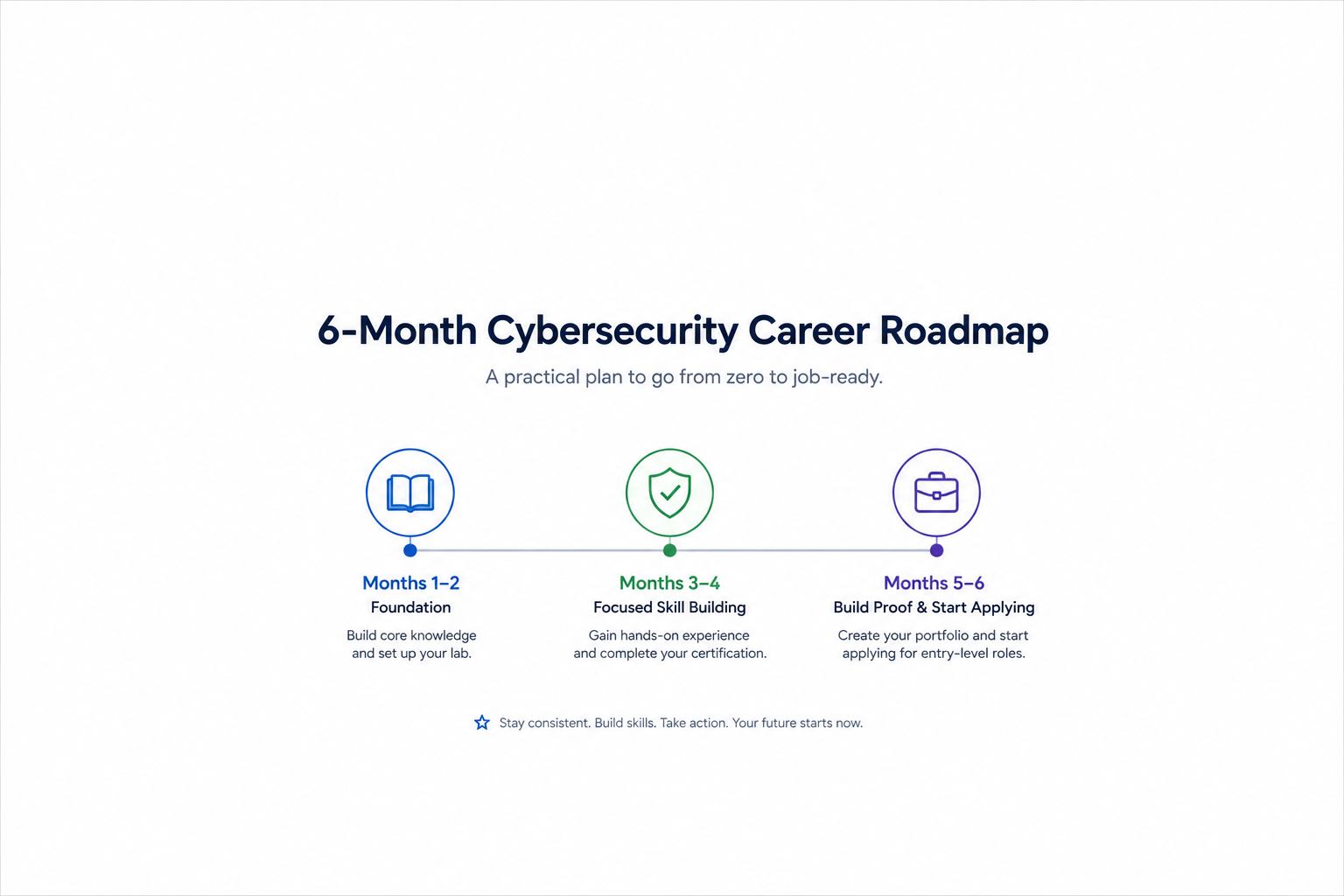
Months One and Two: Foundation
The first phase focuses on building the baseline knowledge that makes everything afterward more efficient, rather than jumping straight into specialized study without context.
Spend this period building foundational understanding of networking basics, operating systems, and core security concepts, through structured free or low-cost resources rather than expensive bootcamp programs at this early stage. Begin studying for a foundational certification (CompTIA Security+ is the standard default for most people entering the field, covered in more depth in a dedicated certification guide) while simultaneously starting to build basic hands-on familiarity, setting up a simple home lab environment, and getting comfortable navigating both Windows and Linux systems at more than a surface level.
The goal for this phase isn’t mastery. It’s building enough foundation that the more focused work in the following months has real context to attach to, rather than studying advanced concepts with no underlying framework to understand why they matter.
Months Three and Four: Focused Skill Building
With foundational knowledge in place, this phase shifts toward building demonstrable, specific capability rather than continuing to accumulate general knowledge.
Complete your foundational certification study and take the exam if you haven’t already. Simultaneously, begin building genuine hands-on projects: expand your home lab with realistic scenarios, work through structured practice platforms, and start documenting what you’re building and learning as you go, since this documentation becomes the concrete evidence a resume and portfolio will eventually need.
This is also the phase to start narrowing your direction, if you haven’t already. Which specific area of cybersecurity is genuinely holding your interest as you build hands-on familiarity? That question is worth real, honest reflection now, since it shapes which specific skills and projects deserve your remaining time in months five and six.
Months Five and Six: Building Proof and Starting the Search
The final phase shifts focus toward assembling concrete proof of your capability and beginning to actively apply, rather than continuing to prepare indefinitely.
Finalize a portfolio that documents your hands-on projects clearly: what you built, what problems you solved, what you learned. Build or update a resume specifically targeting the entry-level roles that match your foundation and interests. Begin actively applying to genuinely accessible entry-level positions, while continuing to build skills in parallel rather than pausing all learning until after you land a role.
This phase also means accepting an uncomfortable but important reality: your first application round likely won’t produce an offer immediately, and that’s normal, not a signal that the previous five months were wasted. Treat early applications and interviews as additional information gathering, what’s actually getting asked, where your preparation feels solid versus shaky, rather than as a pass or fail verdict on the entire effort.
What to Do When You Feel Behind or Stuck
A structured timeline helps, but it doesn’t eliminate the moments of genuine doubt that come with any real career transition. A few things worth remembering when that doubt shows up.
Perfect sequencing matters far less than consistent forward motion. Six months of steady, if imperfect, effort produces dramatically more than six months split between multiple restarted plans chasing a theoretically ideal path. Adjust as you learn, but keep moving rather than starting over from scratch every time new information makes the previous plan feel slightly suboptimal.
Certifications alone were never going to be the whole strategy, and that’s fine. If part of what’s driving hesitation is uncertainty about whether a certification will actually be “enough,” that uncertainty is well-founded, and it’s exactly why this roadmap pairs certification study with hands-on project work throughout, rather than treating a credential as a standalone finish line.
Compare your timeline to your own starting point, not to the fastest success story you’ve read online. Career transition timelines vary enormously based on prior experience, available study time, and circumstances outside your control. A six-month roadmap is a structure to work within, not a guarantee, and adjusting the pace to your actual life circumstances is a reasonable response, not a failure to keep up.
The Bottom Line
The single biggest obstacle for most people trying to break into cybersecurity isn’t a lack of available opportunity or an impossible skills gap. It’s staying in the research and planning phase indefinitely, waiting for enough certainty to feel ready before starting. A structured, time-boxed roadmap, even an imperfect one you’ll adjust as you go, converts that open-ended uncertainty into a concrete plan with a defined shape. Six months from today, having followed a real structure, even loosely, puts you somewhere meaningfully different than six more months of research alone ever will.
Enjoyed this article?
Subscribe to Professor Simon's weekly newsletter for practical insights, career guidance, and leadership lessons delivered every Friday.
A confirmation email will be sent. If you don't receive it, please check your spam or junk folder.
No spam. Unsubscribe anytime.
Prefer to Listen?
Listen to Professor Simon’s IT & Cybersecurity Podcast for practical conversations about cybersecurity careers, certifications, security leadership, and real-world lessons from the field.
Listen on Spotify