Risk Management Basics: A Simple Guide for Business and Career Protection
Risk Management Basics: A Simple Guide for Business and Career Protection
Risk management sounds like something reserved for Fortune 500 companies with dedicated departments and complex software systems. In reality, the same principles that protect major corporations from costly disasters apply directly to individual careers, small businesses, and early-stage projects. Understanding how to identify, categorize, and respond to potential problems before they occur represents one of the most valuable skills for professionals at any level.
The core challenge is simple: Most people operate reactively, addressing problems only after they emerge. This approach leads to unnecessary stress, wasted resources, and missed opportunities. Developing a structured risk management mindset transforms how decisions get made, how concerns get communicated, and how professionals position themselves for advancement. The good news is that effective risk management doesn’t require expensive tools or specialized training—just a systematic approach to thinking about what could go wrong and what to do about it.
Understanding the Three Types of Risk
Every risk falls into one of three categories: human, natural, or technical. Recognizing these distinctions makes it easier to identify vulnerabilities and develop appropriate responses.
Human risks stem from people and their decisions. In cybersecurity contexts, this includes phishing attacks that succeed because employees click malicious links, insider threats from disgruntled staff, or simple mistakes like misconfiguring security settings. Research consistently shows that human error accounts for approximately 74% of cybersecurity incidents, making this category the most significant threat for most organizations. In career contexts, human risks might include miscommunication with team members, unrealistic commitments to stakeholders, or knowledge gaps that prevent effective work.
Natural risks involve events outside human control. These range from obvious disasters like floods or power outages to less dramatic issues like seasonal illness affecting team availability or supply chain disruptions that delay critical equipment. For remote workers and distributed teams, natural risks also include internet outages or weather events that prevent connectivity.
Technical risks relate to tools, systems, and infrastructure. In cybersecurity, this encompasses unpatched software vulnerabilities, hardware failures, or compatibility issues between security tools. For project work, technical risks might involve software bugs, inadequate system capacity, or dependencies on third-party services that could fail or change unexpectedly.
These categories often interact. A technical vulnerability only becomes a problem when a human actor exploits it, or when a natural event like a power surge triggers a system failure. Understanding how risks relate to each other enables more comprehensive protection strategies.
The Four-Part Risk Response Framework
Once risks are identified and categorized, they require a response. Four fundamental strategies form the foundation of risk management: avoid, reduce, accept, or transfer.
Avoidance means eliminating the risk entirely by changing plans or approach. If a project depends on a technology with known security vulnerabilities and no viable patches, choosing a different technology avoids the risk altogether. In career contexts, avoiding might mean declining a project with unrealistic deadlines that could lead to failure and reputational damage. Avoidance is the strongest response but often the least practical, as it may require abandoning valuable opportunities.
Reduction involves implementing controls that lower either the likelihood or impact of a risk. Installing multi-factor authentication reduces the risk of unauthorized access without eliminating it entirely. Creating backup systems reduces the impact of hardware failures. Building extra time into project schedules reduces the likelihood that unexpected delays will cause missed deadlines. According to the Project Management Institute, early risk identification and mitigation reduces project overruns by 20-30%, demonstrating the measurable value of reduction strategies.
Acceptance means acknowledging a risk and choosing to proceed without additional mitigation. This makes sense for low-probability, low-impact risks where the cost of mitigation exceeds the potential damage. A small business might accept the risk of a minor website outage rather than investing in expensive redundant hosting infrastructure. The key to proper acceptance is making the decision consciously and documenting the reasoning, rather than simply ignoring potential problems.
Transfer shifts the risk to another party, typically through insurance or contractual arrangements. Cybersecurity insurance transfers the financial impact of a data breach to an insurance provider. Service level agreements with vendors transfer certain operational risks to the service provider. Transfer doesn’t eliminate the risk but changes who bears the consequences.
Building a Personal Risk Management Practice
Applying risk management principles to career development and daily work creates tangible advantages. The process starts with systematic identification of potential problems.
Begin by identifying goals and desired outcomes. For a career changer entering cybersecurity, the goal might be securing an entry-level security analyst position within six months. For a small MSP owner, the goal might be maintaining client retention while scaling operations.
Next, map potential obstacles to those goals. What could prevent achievement? For the job seeker, obstacles might include insufficient technical knowledge (human risk), competition from more experienced candidates (human risk), or economic conditions that limit hiring (natural risk). For the MSP owner, risks might include client data breaches (technical and human risks), staff turnover (human risk), or service outages affecting multiple clients (technical risk).
Categorize each identified risk using the three-type framework. This reveals patterns and helps prioritize attention. If most risks are human-related, focus areas become training, communication, and process documentation. If technical risks dominate, infrastructure investment and maintenance become priorities.
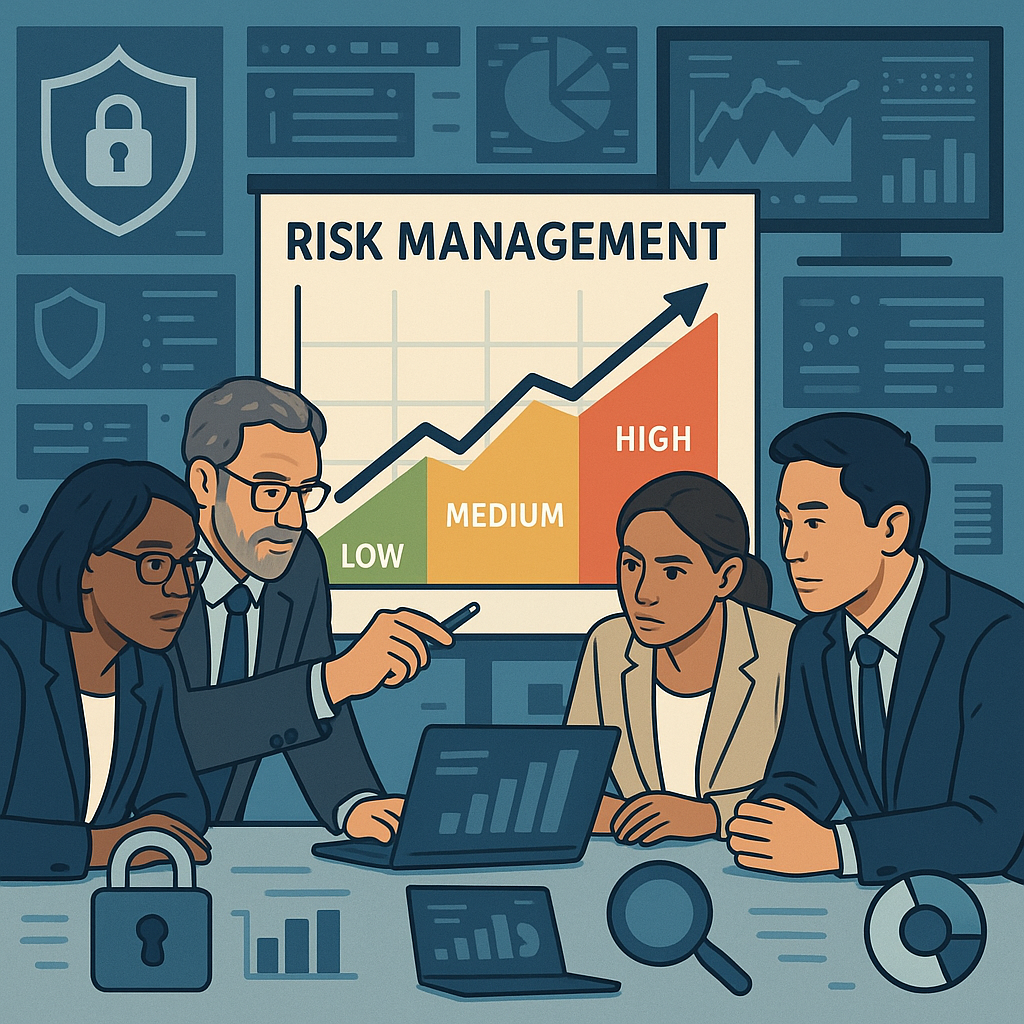
Assess probability and impact for each risk. Simple scales work well: rate likelihood as low, medium, or high, and rate potential impact similarly. Risks that rate high in both categories demand immediate attention. Risks with low likelihood and low impact can often be accepted without further action.
Choose appropriate responses using the four-part framework. A career changer might reduce the skill gap risk by completing relevant certifications, accept the competition risk while differentiating through networking, and avoid certain geographic markets where hiring is particularly weak.
Document the assessment and chosen responses. This serves multiple purposes: it creates accountability for following through on mitigation actions, provides evidence of strategic thinking for performance reviews or interviews, and establishes a baseline for monitoring whether risks evolve over time.
Common Risk Management Mistakes and Misconceptions
Several widespread misconceptions limit the effectiveness of risk management efforts, particularly for those new to the practice.
The belief that risk management is only relevant for large organizations or disaster scenarios prevents many individuals and small businesses from developing protective practices. In reality, the principles apply to decisions at every scale. Thinking through what could go wrong when accepting a new client, starting a project, or making a career move represents practical risk management that prevents common failures.
Over-reliance on qualitative assessment creates false confidence. Describing a risk as “medium likelihood” feels scientific but lacks precision. Practitioners in quantitative risk analysis demonstrate that this approach can lead to 30-50% failure rates in accurately predicting threats. While beginners may start with simple qualitative scales, adding even basic quantitative elements—like estimating percentage likelihood or dollar impact—significantly improves decision quality.
Treating all identified risks as requiring mitigation wastes resources and creates unnecessary complexity. Organizations and individuals with mature risk management practices consciously accept many risks after determining that mitigation costs exceed potential impact. The goal is not zero risk but optimal risk—accepting appropriate levels while protecting against catastrophic scenarios.
Viewing risk management purely as a defensive practice misses its strategic value. Understanding threats better than competitors or peers creates opportunities. A cybersecurity professional who thoroughly understands supply chain risks can identify market gaps for services addressing those vulnerabilities. A project manager who anticipates and communicates risks early builds trust with stakeholders even when problems occur.
Failing to monitor risks continuously undermines the entire practice. Risk landscapes change as projects progress, markets evolve, and new threats emerge. A quarterly review of identified risks and their status takes minimal time but prevents surprises from risks that were previously low-priority but have since intensified.
Risk Management in Cybersecurity Contexts
For those entering cybersecurity or managing IT security for small businesses, risk management principles translate directly into protective practices.
The NIST Cybersecurity Framework provides a structured approach that aligns with general risk management concepts. Its five functions—Identify, Protect, Detect, Respond, and Recover—map to the risk management cycle. Identification involves asset inventory and vulnerability assessment. Protection corresponds to risk reduction through controls. Detection enables faster response to threats that bypass preventive measures. Response and Recovery address accepted risks by planning for incident management and business continuity.
Small businesses and individual practitioners often struggle with where to start. Focus on the highest-impact, most-likely risks first:
The human risk of phishing deserves immediate attention given its prevalence. Reducing this risk requires security awareness training, email filtering tools, and clear procedures for reporting suspicious messages. These controls are relatively inexpensive and address the attack vector responsible for most breaches.
Technical risks from unpatched software demand regular attention. Establishing a patch management process reduces vulnerability exposure. For small operations, this might mean simply enabling automatic updates for workstations and scheduling monthly reviews of server patches.
The technical risk of data loss requires backup systems. The 3-2-1 rule provides clear guidance: maintain three copies of data, on two different media types, with one copy offsite. Cloud backup services enable small operations to implement this enterprise-level protection affordably.
The human risk of excessive access permissions often goes unaddressed in small organizations. Implementing least privilege—where users receive only the access necessary for their roles—significantly reduces potential damage from compromised accounts or insider threats.
Transfer strategies through cybersecurity insurance deserve consideration once basic controls are in place. Insurance doesn’t prevent incidents but limits financial impact. Carriers increasingly require specific controls before offering coverage, creating incentive to implement foundational protections.
Developing the Risk Management Mindset
Beyond specific techniques and frameworks, effective risk management requires a particular way of thinking about decisions and change.
Cultivate systematic skepticism without becoming paralyzed by potential problems. The question “what could go wrong?” should inform every significant decision, but asking the question shouldn’t prevent action. The goal is making informed decisions about which risks to take, not avoiding all risk.
Document thinking even when decisions seem obvious. Writing down identified risks and chosen responses takes minutes but creates valuable records that demonstrate judgment over time. For early-career professionals, this documentation becomes portfolio evidence of strategic thinking. For business owners, it establishes baseline assumptions that can be reviewed if circumstances change.
Communicate risks appropriately to stakeholders. This requires balancing between unnecessary alarm and failure to raise legitimate concerns. Effective risk communication includes the identified threat, its potential impact, the assessed likelihood, and recommended responses. Presenting this information positions professionals as strategic thinkers rather than chronic worriers.
Learn from both successful mitigation and realized risks. When a mitigation strategy prevents a potential problem, acknowledge and document what worked. When a risk materializes despite precautions, conduct an honest assessment of whether the initial assessment was accurate, whether the chosen response was appropriate, and what adjustment would improve future outcomes.
Recognize that risk management creates competitive advantage. Organizations and individuals who identify and address risks earlier than peers avoid preventable failures and capitalize on opportunities that others overlook. In cybersecurity markets, businesses that can demonstrate mature risk management practices differentiate themselves in client acquisition and retention.
Practical Implementation for Different Contexts
The application of risk management principles varies based on specific contexts, but the underlying framework remains consistent.
For students and recent graduates, risk management builds valuable career skills while protecting academic and early professional success. Applying the framework to group projects—identifying potential coordination problems, technical challenges, and resource constraints—prevents common failures while demonstrating maturity in thinking. Documenting this process creates interview talking points that illustrate strategic capability.
For career changers entering cybersecurity or IT, risk assessment of the transition itself provides clarity. Identifying knowledge gaps (human risk) suggests specific training priorities. Recognizing credential requirements (technical risk) informs certification planning. Understanding market conditions (natural risk) guides job search strategy and timeline expectations. Explicitly managing the career transition as a project with identifiable risks increases success likelihood.
For small business owners and solo practitioners, risk management prevents the chronic firefighting that consumes productive time. Monthly risk reviews—taking perhaps 30 minutes to identify emerging threats and assess existing controls—create space for proactive improvement rather than constant crisis response. Research from enterprise risk management implementations shows that organizations using structured approaches reduce residual risk by approximately 60% through consistent attention and control testing.
For early to mid-career professionals in larger organizations, demonstrating risk management capability creates advancement opportunities. Raising concerns appropriately, proposing mitigation strategies, and documenting risk thinking in project plans positions individuals as strategic contributors rather than tactical executors. This visibility becomes particularly valuable when organizations face crises and need to identify capable people for expanded responsibility.
Moving Beyond Reactive Operations
The transition from reactive to proactive operations represents the fundamental value of risk management. Instead of constant surprise at problems that should have been anticipated, systematic risk thinking creates resilience and preparedness.
This shift doesn’t eliminate all problems—risk management is not magic that prevents every negative outcome. Markets still shift unexpectedly, people still make mistakes despite training, and systems still fail despite maintenance. The difference is that anticipated risks receive appropriate attention and mitigation before they become crises, and even unanticipated problems get addressed more effectively by teams and individuals practiced in systematic response.
For those beginning to develop risk management skills, start with small-scale applications rather than attempting comprehensive enterprise-level processes. Identify risks for a single project or a specific career decision. Choose one or two appropriate responses and implement them. Document the process and outcome. Build the habit through repeated practice on manageable scope before scaling to larger, more complex applications.
The investment in developing risk management capability pays dividends throughout careers and across changing circumstances. The framework applies equally to technical decisions, strategic planning, client relationships, and personal career navigation. Unlike technical skills that may become obsolete as technology evolves, the ability to systematically identify, assess, and respond to threats remains valuable indefinitely.
Risk management transforms from an abstract business concept to a practical daily skill when applied consistently to real decisions and challenges. The professionals and organizations that develop this capability distinguish themselves through resilience, preparedness, and the strategic thinking that turns potential threats into competitive advantages.
Enjoyed this article?
Subscribe to Professor Simon's weekly newsletter for practical insights, career guidance, and leadership lessons delivered every Friday.
A confirmation email will be sent. If you don't receive it, please check your spam or junk folder.
No spam. Unsubscribe anytime.
Prefer to Listen?
Listen to Professor Simon’s IT & Cybersecurity Podcast for practical conversations about cybersecurity careers, certifications, security leadership, and real-world lessons from the field.
Listen on Spotify