Post-Quantum Cryptography: What It Means for You Now
The encryption protecting online banking, messaging apps, and sensitive corporate data faces a challenge that sounds like science fiction but isn’t: quantum computers, machines that process information in a fundamentally different way from anything in use today, will eventually be powerful enough to break the mathematical problems modern encryption relies on. That assumption of permanence, that today’s encrypted data stays effectively unreadable to anyone without the key, creates a false sense of security that’s already outdated for a specific and important category of information.
This isn’t a distant, purely theoretical concern reserved for cryptographers and government agencies. It’s a shift already reshaping security planning today, with a genuinely urgent twist: some of the risk isn’t years away at all. It’s happening right now.
Why Quantum Computers Actually Threaten Encryption
Modern encryption protecting everything from online banking to private messaging relies on mathematical problems that are, for a conventional computer, computationally impractical to solve through brute force, not impossible in a strict mathematical sense, but requiring so much computing time that they’re effectively unbreakable with current technology.
Quantum computers process information in a fundamentally different way, using quantum mechanical properties that let them solve specific categories of mathematical problems, including the ones underlying widely used encryption methods, dramatically faster than any conventional computer ever could. A sufficiently powerful, fully realized quantum computer wouldn’t need millions of years to break certain types of encryption. It could potentially do so in a dramatically shorter timeframe.
Fully operational quantum computers capable of breaking current encryption at scale don’t exist yet, and credible estimates place that capability years away rather than around the corner. That timeline gap is exactly why this topic gets dismissed as premature by people who haven’t looked closely at the second half of the threat.
The Threat That’s Already Here: Harvest Now, Decrypt Later
Encrypted data flowing through networks today carries something most organizations don’t fully account for: an expiration date on its confidentiality. Adversaries with sufficient resources, including sophisticated criminal organizations and nation-state actors, are already collecting and storing encrypted communications, intellectual property, and sensitive records today, with the explicit intention of decrypting them once quantum computing capability catches up.
This strategy, commonly called “harvest now, decrypt later,” means the timeline for quantum computing to become a genuine threat isn’t measured from today. It’s measured from whenever your currently encrypted data was originally captured. Information that needs to remain confidential for a long time, medical records, government and defense communications, trade secrets, long-term financial data, is already exposed to this future decryption risk today, even though no quantum computer capable of actually breaking that encryption exists yet.
This is precisely why organizations handling long-lived sensitive data are moving on post-quantum preparation now rather than waiting until quantum computers actually arrive. By the time the threat becomes fully realized, any data already harvested becomes readable retroactively, and no future security upgrade can protect information that was already copied and stored years earlier.
What Post-Quantum Cryptography Actually Is
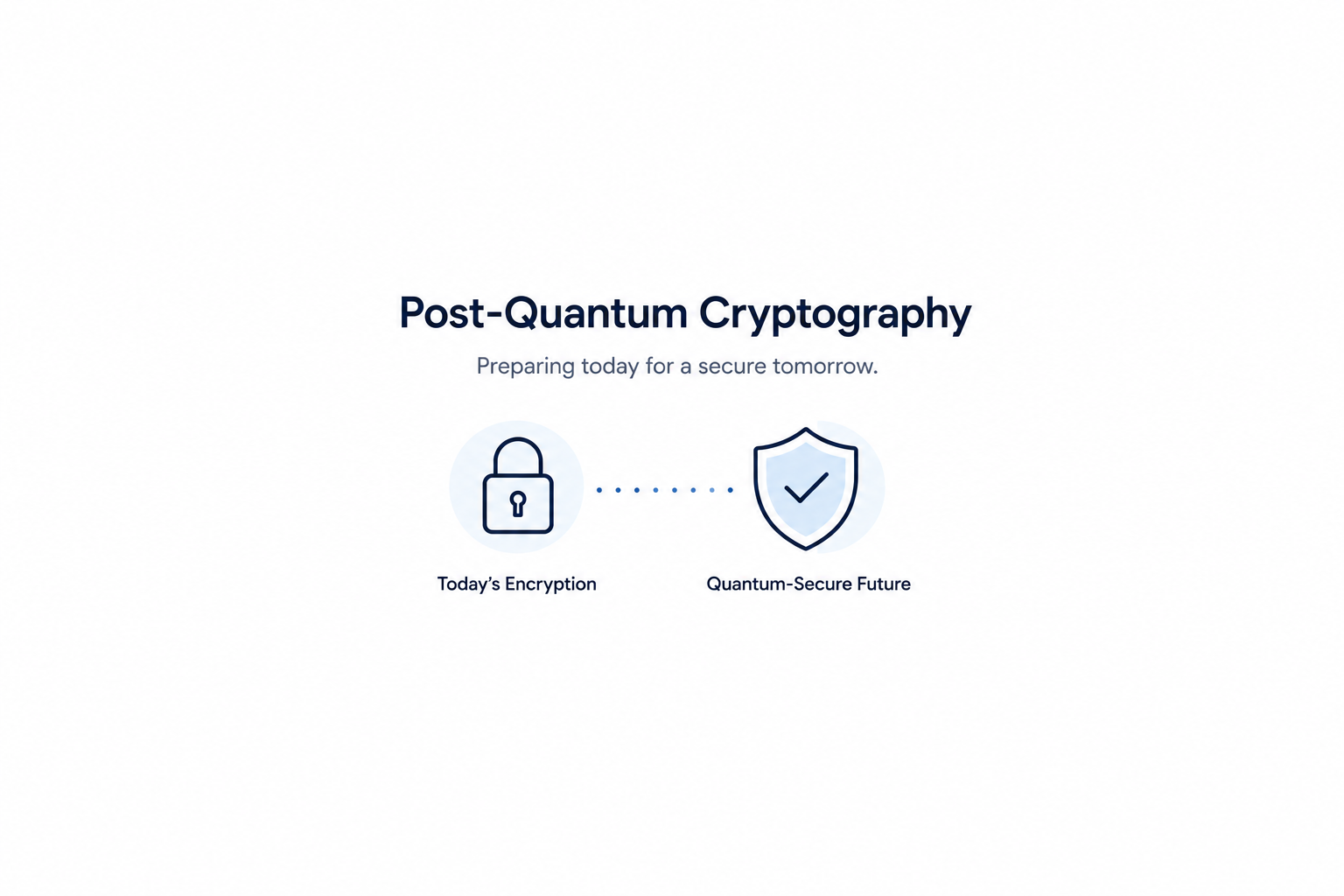
Post-quantum cryptography refers to a new generation of encryption methods specifically designed to remain secure even against attacks from quantum computers, unlike current widely used encryption, which quantum computers are expected to eventually break.
These new methods rely on different mathematical problems, ones that remain computationally impractical even for quantum computers to solve efficiently, rather than the problems current encryption depends on that quantum computers are specifically well-suited to attack. Standards bodies and major technology organizations have been actively developing, testing, and beginning to formalize these new cryptographic standards, with the goal of giving organizations a viable path to transition before quantum computing capability actually matures.
Importantly, adopting post-quantum cryptography doesn’t require understanding the underlying mathematics any more than using current encryption requires understanding its mathematics today. What it requires is organizational awareness that a transition is coming, and planning for that transition on a realistic timeline rather than waiting until it becomes an emergency.
Why This Matters for Your Digital Future, Concretely
Quantum computing can feel abstract and distant, but its implications touch specific, concrete parts of everyday digital life that are worth understanding directly.
Online banking and financial transactions currently rely on encryption standards that fall within the category quantum computers are expected to eventually break. Financial institutions handling long-term account data and transaction histories represent exactly the kind of long-lived sensitive information that harvest-now-decrypt-later strategies target today, even though the actual decryption capability remains years off.
Healthcare records carry long confidentiality requirements, often needing protection for decades, making them a particularly clear example of data where today’s encryption choices need to account for a threat that won’t fully materialize for years, because the data itself will still need protecting when that threat does arrive.
Government, defense, and corporate intellectual property represent the highest-priority targets for harvest-now-decrypt-later collection today, given the potential value of that information remaining exploitable even years into the future.
Ordinary personal communications and data, while a lower-priority target for this specific kind of long-term collection compared to the categories above, will still eventually need to migrate to post-quantum standards as those standards become the default across major platforms and services, a transition that will likely happen gradually and largely invisibly to most users, similar to how previous encryption standard upgrades have rolled out.
What’s Actually Happening Right Now
This transition isn’t purely theoretical planning for an eventual future. Standards organizations have been finalizing post-quantum cryptographic standards, and major technology companies and platforms have begun implementing and testing them in real systems. Organizations handling particularly sensitive or long-lived data, financial institutions, government agencies, healthcare systems, are increasingly building post-quantum migration into their security roadmaps now, specifically because of the harvest-now-decrypt-later risk rather than waiting for quantum computers to actually arrive.
For most individuals and smaller organizations, the practical takeaway isn’t an urgent need to personally implement post-quantum cryptography today. It’s awareness: understanding that this transition is underway, that any data intended to remain confidential for many years already carries this specific risk today regardless of when quantum computers actually mature, and that this is a topic worth genuine attention rather than dismissal as distant science fiction.
The Bottom Line
Post-quantum cryptography addresses a threat that sounds distant but has an already-active dimension hiding within it. Fully capable quantum computers remain years away, but the harvest-now-decrypt-later strategy means sensitive data encrypted today, using today’s standards, is already exposed to a future decryption risk that no amount of waiting will undo retroactively. Understanding this distinction, between the far-off full threat and the already-active collection risk, is what separates organizations and individuals making informed decisions about long-term data protection from those treating this as a problem for someone else to worry about later.
Enjoyed this article?
Subscribe to Professor Simon's weekly newsletter for practical insights, career guidance, and leadership lessons delivered every Friday.
A confirmation email will be sent. If you don't receive it, please check your spam or junk folder.
No spam. Unsubscribe anytime.
Prefer to Listen?
Listen to Professor Simon’s IT & Cybersecurity Podcast for practical conversations about cybersecurity careers, certifications, security leadership, and real-world lessons from the field.
Listen on Spotify