Finding Your Cybersecurity Career Fit: A Complete Guide
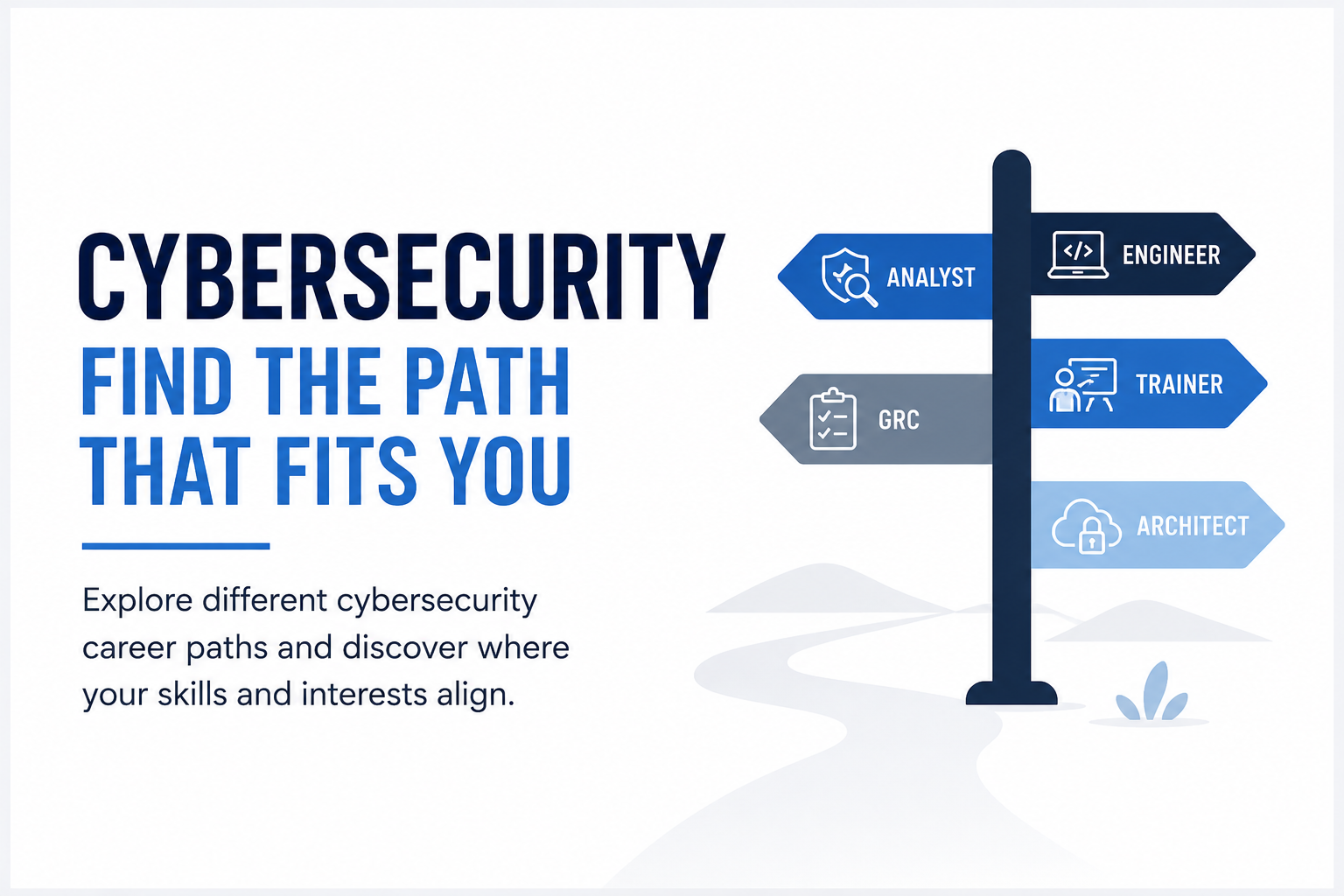
Cybersecurity attracts diverse talent, yet many potential professionals feel paralyzed by choice. The field encompasses dozens of distinct roles, from technical positions requiring deep systems knowledge to business-focused careers built on communication and policy. Someone who investigates security incidents and hunts threats has almost nothing in common day to day with someone who writes security policy or trains employees on phishing awareness, even though both hold “cybersecurity” job titles.
This is the part career guides skip past. Most advice focuses on how to break into the field generally, without addressing the harder, more useful question first: which part of this field actually fits how you think, work, and want to spend your day? Getting that answer wrong doesn’t just mean a rough first year. It means building skills and certifications around a specialization you may end up disliking. This guide walks through how to figure that out before you commit.
Why “Cybersecurity” Isn’t One Job
The first mental shift worth making: cybersecurity is not a single career, it’s an umbrella covering a genuinely wide range of work styles. A few honest contrasts:
Investigation-driven work versus creation-driven work. Some roles (security operations, incident response, digital forensics) center on reactive investigation: something happened, figure out what and why. Other roles (security architecture, secure development, policy writing) center on building something from scratch: designing a system, a process, or a document that didn’t exist before.
Technical depth versus business communication. Some paths reward going deep into a narrow technical skill (penetration testing, malware analysis, cloud security engineering). Others reward the ability to translate technical risk into language executives and non-technical employees actually understand (governance, risk and compliance, security awareness training).
Structured, procedural work versus ambiguous, exploratory work. Some roles follow well-defined playbooks with clear escalation paths. Others require comfort with genuine ambiguity: no clear answer, no established procedure, just judgment.
None of these are better or worse than the others. They’re different jobs that happen to share an industry and, often, a shared foundational vocabulary. The mismatch that causes career dissatisfaction usually isn’t “I’m not good at cybersecurity.” It’s “I picked the wrong kind of cybersecurity work for how I actually like to operate.”
Personality Traits That Matter More Than Most Career Guides Admit
Career guidance in cybersecurity often emphasizes certifications and technical skills, but during the first several years, personality traits (how someone naturally approaches problems, handles pressure, and prefers to communicate) predict day-to-day satisfaction more reliably than credentials do.
How you handle repetition and ambiguity. Some roles (SOC analyst work, for instance) involve highly repetitive investigation of similar alerts, most of which turn out to be nothing. Others involve almost no repetition at all: every engagement, every policy question, every incident is different. If sustained repetitive focus feels satisfying rather than draining, roles built around monitoring and triage may suit you. If unpredictability and variety energize you more than routine, roles built around consulting, incident response leadership, or red team work may fit better.
How you prefer to solve problems: alone or with others. Some cybersecurity work is genuinely solitary, hours of focused technical analysis with minimal interruption. Other work is constantly collaborative: security awareness roles, GRC positions, and security program management all involve near-continuous interaction with other departments.
Your relationship with risk and stress. Incident response and SOC work involve real time pressure, sometimes at 2 a.m., sometimes with significant consequences riding on a fast, correct decision. Other paths (security architecture, compliance documentation, policy development) involve deadlines but rarely the acute, immediate pressure of an active incident. Being honest about how you perform under that kind of pressure, not how you’d like to perform, matters here.
Whether you’re energized by depth or breadth. Specialist roles reward going deep into one narrow domain for years. Generalist roles (security program management, early-career GRC, security awareness) reward staying broadly competent across many domains without going deep into any single one. Neither is a lesser path, but they feel very different day to day.
Seven Questions Worth Asking Yourself
Rather than a personality quiz with a definitive verdict, these questions are more useful as an honest self-check before committing time and money to a specific path.
1. When something breaks, do I want to be the one investigating why, or the one who prevents it from breaking in the first place? The first answer points toward incident response, digital forensics, or SOC work. The second points toward security architecture, secure development, or risk management.
2. Do I want to explain technical risk to people who aren’t technical, or do I want to go deep into technical systems most people never see? The first points toward GRC, security awareness, or security leadership. The second points toward penetration testing, malware analysis, or cloud security engineering.
3. Am I comfortable with shift work and unpredictable hours, or do I need a stable, predictable schedule? Many SOC and incident response roles involve rotating shifts or on-call expectations, particularly early on. Compliance, policy, and architecture roles are far more likely to run on standard business hours.
4. Do I want to build things or find things that are broken? Building points toward secure development, architecture, and engineering. Finding points toward penetration testing, threat hunting, and auditing.
5. Would I rather follow an established playbook well, or make judgment calls in situations without a clear precedent? Structured, procedural comfort points toward SOC and compliance work. Comfort with ambiguity points toward incident response leadership, consulting, and red team work.
6. Do I care more about the technical mechanics of an attack, or the business and human impact of one? Technical mechanics points toward the offensive and technical defensive specializations. Business and human impact points toward risk management, GRC, and security awareness.
7. What kind of work did I actually enjoy in a previous job or project, independent of the subject matter? If you liked investigating problems methodically, that instinct transfers directly to security operations. If you liked writing clear documentation and processes, that transfers to policy and governance. If you liked teaching or explaining things to others, that transfers to security awareness and training. Your answer here is often the single most reliable predictor of fit, because it’s evidence from your actual working life rather than a guess about an unfamiliar field.
Sampling Before You Commit
Personality self-assessment gets you a reasonable starting hypothesis, not a verdict. The more reliable way to confirm fit is sampling actual work in a few different specializations before investing heavily in one certification path.
Try structured exercises in more than one domain. Free platforms offer beginner-friendly, hands-on practice across SOC-style alert investigation, penetration testing fundamentals, and digital forensics. Spending a few hours in each, rather than diving deep into just one, reveals genuine preference far faster than reading about the roles does.
Read real job descriptions, not just role summaries. A GRC analyst posting and a security engineer posting describe genuinely different daily work. Reading ten real postings in a specialization you’re considering, and honestly assessing whether the described responsibilities sound appealing, is a fast, free way to reality-test an assumption.
Talk to someone actually doing the job. A fifteen-minute conversation with a working professional in a specific specialization reveals more about daily reality than hours of general career content, because it surfaces the parts of the job nobody puts in a glossy career guide (the tedious parts, the stressful parts, the parts that turned out to be more interesting than expected).
Notice what you gravitate toward without being told to. When you’re free to explore any cybersecurity topic out of curiosity, which one do you actually click on? That unprompted interest is real data, arguably more honest than any answer you’d give to a direct self-assessment question.
Choosing a First Path Without Overcommitting
A first specialization choice doesn’t need to be permanent, and treating it that way creates unnecessary pressure. Most cybersecurity careers involve lateral moves between specializations as people discover what they actually enjoy once they’re doing real work rather than studying it abstractly.
That said, a reasonable starting choice, one that matches your honest answers above rather than whichever path sounds most impressive, sets you up for a faster, more sustainable start than picking based on salary headlines or a certification’s popularity alone. The professionals who advance fastest generally aren’t the ones who picked the “best” specialization in the abstract. They’re the ones who picked a specialization that matched how they actually like to work, then built real competence in it because the daily work sustained their interest long enough to get good at it.
Enjoyed this article?
Subscribe to Professor Simon's weekly newsletter for practical insights, career guidance, and leadership lessons delivered every Friday.
A confirmation email will be sent. If you don't receive it, please check your spam or junk folder.
No spam. Unsubscribe anytime.
Prefer to Listen?
Listen to Professor Simon’s IT & Cybersecurity Podcast for practical conversations about cybersecurity careers, certifications, security leadership, and real-world lessons from the field.
Listen on Spotify