The CIA Triad Explained: Cybersecurity’s Core Framework
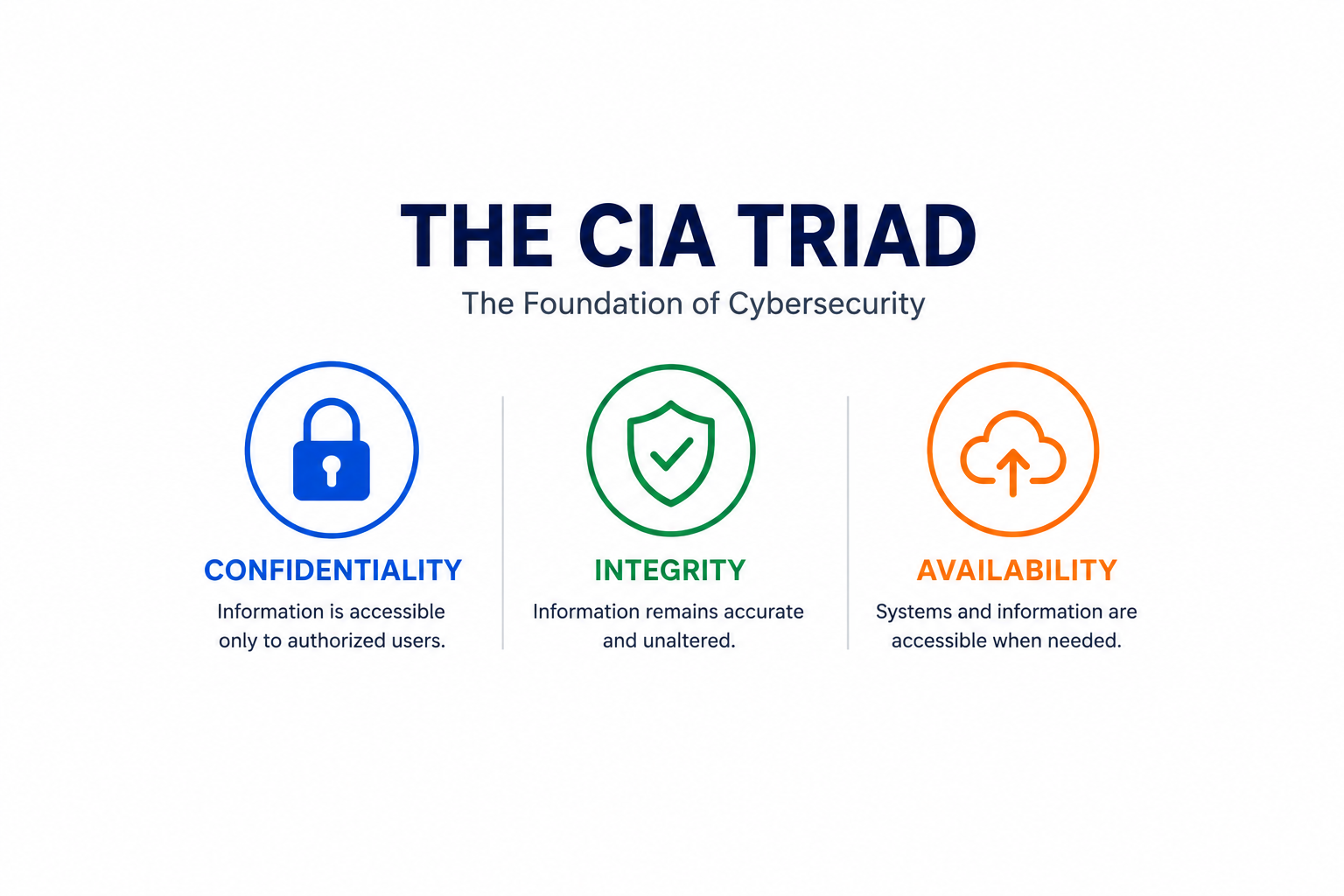
Every cybersecurity decision revolves around three fundamental principles. Whether protecting a personal password, securing a small business, or implementing an enterprise security strategy, the same underlying concepts guide the approach. The CIA Triad, confidentiality, integrity, and availability, forms the foundation almost every security control, policy, and decision ultimately traces back to. Understanding it isn’t just academic. It’s the mental model that lets you evaluate any security decision, technical or not, and reason about what it’s actually protecting and why.
The Three Pillars, Defined Clearly
Confidentiality means information stays accessible only to the people authorized to see it. This is the property most people instinctively associate with security: keeping data away from anyone who shouldn’t have it. Passwords, encryption, access controls, and authentication systems all exist primarily to protect confidentiality.
Integrity means information stays accurate and unaltered except by authorized action. A confidential record that’s been secretly modified is arguably more dangerous than one that was simply exposed, because the people relying on it don’t know it’s been changed. Integrity controls include checksums, digital signatures, version control, and audit logs that detect unauthorized changes.
Availability means information and systems remain accessible to authorized users when they’re needed. A perfectly confidential, perfectly accurate system that’s offline when someone needs it has still failed at its job. Availability controls include backups, redundancy, disaster recovery planning, and defenses against denial-of-service attacks.
The three properties work together, and importantly, they sometimes pull against each other. A highly encrypted system (strong confidentiality) that takes ten extra steps to access can hurt availability. A system aggressively locked down against any modification (strong integrity) can make legitimate updates slower and harder. Good security design isn’t maximizing all three independently; it’s finding the right balance for the specific data and system in question.
Why This Framework Matters Beyond Theory
The CIA Triad isn’t just a way to categorize security controls after the fact. It’s a practical tool for evaluating any security decision before you make it, by asking which of the three properties a given control actually protects, and whether that’s the property that matters most for this specific situation.
Consider a common real-world tension: a company wants to require multi-factor authentication for every internal system, including ones used for time-sensitive customer support. Multi-factor authentication strengthens confidentiality. But if it’s implemented in a way that frequently locks out support staff during a live customer call, it’s actively damaging availability, in a context where availability might be the more business-critical property. Naming this tradeoff explicitly, using the CIA framework, turns a vague “security versus convenience” argument into a specific, resolvable conversation about which property matters most for this particular system.
Know What You’re Protecting Before You Apply the Framework
Most cybersecurity professionals start their careers focused on tools, certifications, and technical controls, firewalls, encryption algorithms, intrusion detection systems, without first asking the more fundamental question: what exactly are we protecting, and why does it matter?
The CIA Triad only becomes useful once you’ve identified what data and systems actually matter to your specific organization. Not everything deserves the same level of protection. A public marketing brochure and a customer database with payment information both technically involve “data,” but they warrant entirely different levels of confidentiality investment. Treating everything as equally critical wastes resources on low-value protection while sometimes under-protecting what actually matters.
A practical starting point: inventory what data and systems your organization actually holds, then classify each by how much damage would result from a confidentiality failure, an integrity failure, or an availability failure specifically. A hospital’s patient treatment records demand extremely high integrity (a wrong medication dosage recorded incorrectly can be fatal) and strong confidentiality, but during an emergency, availability may briefly outweigh both, a doctor needing immediate access to a record can’t wait for an elaborate authentication process. This kind of specific, asset-by-asset thinking is what separates security programs that allocate resources effectively from ones that apply the same generic controls everywhere regardless of what’s actually at stake.
How Priorities Shift by Industry
Organizations often implement security measures without considering whether those controls actually align with their specific business requirements. The CIA Triad’s three properties don’t carry equal weight everywhere; the right balance depends heavily on what an organization actually does.
Healthcare organizations typically prioritize integrity and availability alongside confidentiality in a way that’s more balanced than most industries. Inaccurate patient data (an integrity failure) can cause direct physical harm, and systems being unavailable during emergency care can be equally dangerous. Confidentiality still matters enormously given the sensitivity of health information, but it doesn’t automatically outweigh the other two properties the way it might elsewhere.
Financial services organizations lean heavily on integrity, since even small unauthorized alterations to transaction records or account balances create direct financial and legal consequences, alongside strong confidentiality given the sensitivity of financial data.
E-commerce and retail platforms often prioritize availability especially heavily, since downtime translates directly and immediately into lost revenue, while still maintaining strong confidentiality for payment and customer data.
Government and defense contexts frequently prioritize confidentiality above the other two properties, given the consequences of classified or sensitive information exposure, sometimes accepting more friction in availability as a reasonable tradeoff.
Understanding your specific industry’s natural priorities helps explain why a security control that makes sense in one context, an elaborate multi-step authorization process, for example, might be entirely reasonable in a government context and genuinely counterproductive in an e-commerce context where speed and availability drive the business.
Applying the Triad to Everyday Decisions
The framework scales down to personal and small-business security just as usefully as it scales up to enterprise systems.
For personal security, confidentiality shows up as unique, strong passwords and multi-factor authentication protecting your accounts from unauthorized access. Integrity shows up as verifying that a message, email, or file actually came from who it claims to be from, unaltered. Availability shows up as maintaining backups, so a device failure or ransomware attack doesn’t mean permanently losing access to your own data.
For a small business without a dedicated security team, the same framework provides a simple starting checklist: what customer or business data would cause real damage if exposed (confidentiality), what records would cause real damage if silently altered (integrity), and what systems would cause real damage if they went offline for a day (availability)? Answering those three questions concretely, even informally, does more to focus limited security resources than adopting a long generic best-practices checklist without first understanding your own specific risk profile.
The Bottom Line
The CIA Triad endures as cybersecurity’s foundational framework because it’s genuinely simple enough to apply to any security decision, personal or enterprise, technical or organizational, while still being specific enough to resolve real tradeoffs. Confidentiality, integrity, and availability aren’t three separate checklists to satisfy independently. They’re three lenses for asking the same underlying question about any system or piece of data: what would go wrong here, specifically, and which of these three properties would have prevented it?
Understanding this framework, and more importantly, understanding what your own organization or personal digital life actually needs protected and why, turns abstract security advice into concrete, prioritized decisions.
Enjoyed this article?
Subscribe to Professor Simon's weekly newsletter for practical insights, career guidance, and leadership lessons delivered every Friday.
A confirmation email will be sent. If you don't receive it, please check your spam or junk folder.
No spam. Unsubscribe anytime.
Prefer to Listen?
Listen to Professor Simon’s IT & Cybersecurity Podcast for practical conversations about cybersecurity careers, certifications, security leadership, and real-world lessons from the field.
Listen on Spotify