Day in the Life: SOC Analyst vs. GRC Analyst
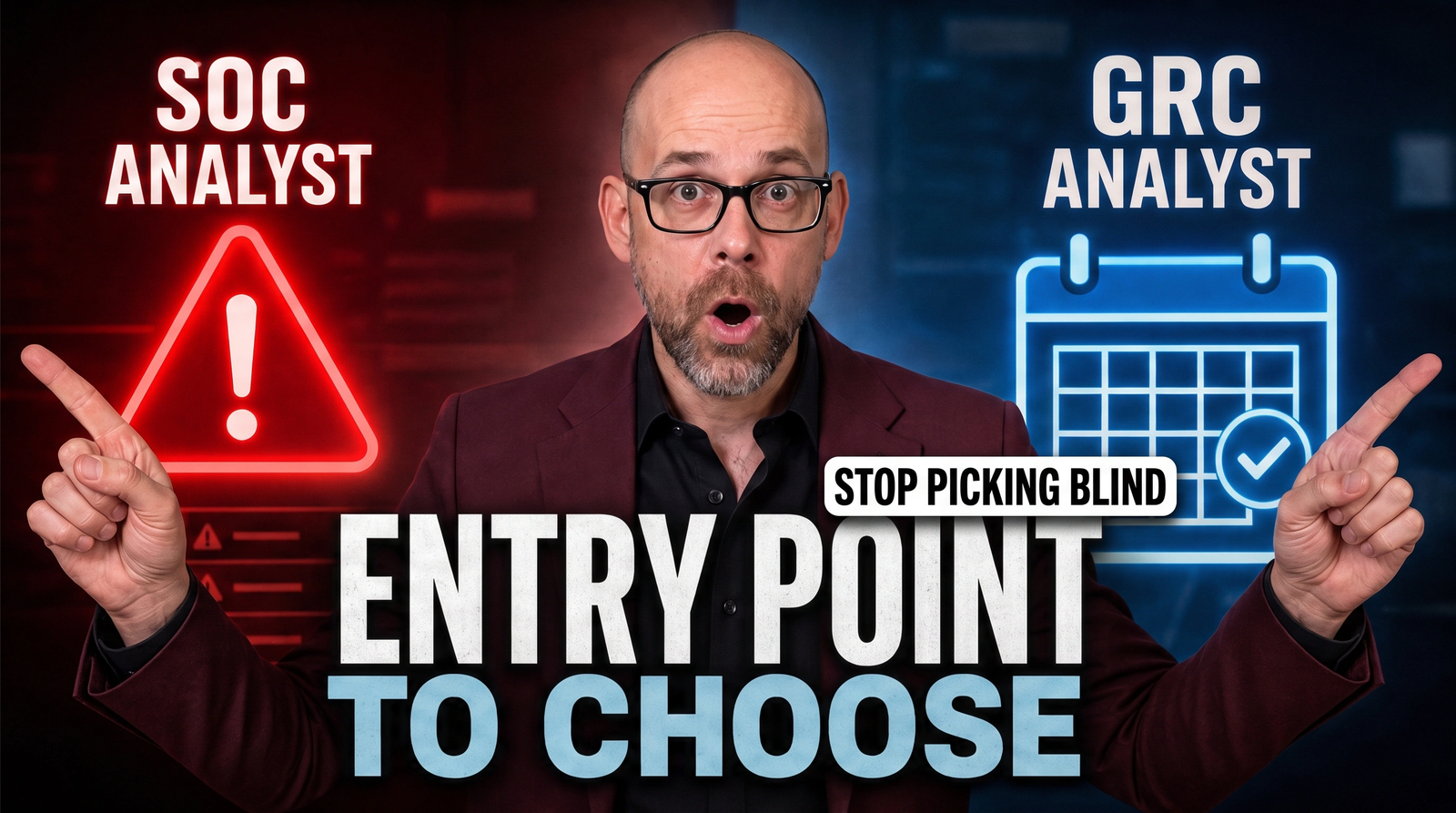
Two of the most common entry points into cybersecurity look nothing alike once someone’s actually doing the job. A SOC Analyst and a GRC Analyst might sit in the same building, report up through the same security leadership, and both call themselves “entry-level security professionals.” Day to day, they’re doing almost entirely different work, using different skills, and living in a different rhythm entirely.
Picking between them based on a job title alone is picking blind. Here’s what each one actually looks like, hour by hour.
Prefer to read the full breakdown? Keep scrolling. Prefer to watch? Full video above.
A SOC Analyst’s Day
The day usually starts with a shift handoff. Whoever worked the previous shift walks through what’s still open, what got escalated overnight, and what to keep an eye on. From there, most of the day centers on a queue, a running list of security alerts generated by monitoring tools, each one needing a decision. Is this a real threat, or noise. If it’s real, how serious, and what happens next.
A typical alert might be an unusual login from an unfamiliar location, a spike in outbound traffic from a workstation, or a file flagged by antivirus software. The analyst pulls context, checks logs, correlates what’s happening across a few different systems, and decides whether to close the alert, escalate it, or start a deeper investigation. Some days are quiet, a slow trickle of false positives. Other days bring a real incident that consumes hours of focused, high-pressure work, tracing exactly what happened, containing it, and documenting every step for whoever picks up the investigation next.
The pace is reactive by nature. A SOC Analyst doesn’t usually choose what to work on next, the queue chooses for them. That rhythm rewards people who like structure, pattern recognition, and staying calm under time pressure, and it can wear on people who need more autonomy over how their day unfolds.
A GRC Analyst’s Day
A GRC Analyst’s day starts very differently, usually with a calendar rather than a queue. The work is project-based and often spans weeks, not minutes. A typical week might include reviewing a vendor’s security questionnaire before a contract gets signed, updating a risk register after a new system goes live, preparing evidence for an upcoming SOC 2 audit, or sitting in a meeting translating a new regulatory requirement into something a specific business unit actually needs to do differently.
Much of the work is reading, writing, and talking to people who aren’t security professionals. Explaining why a particular control matters to a department that sees it as friction. Interpreting a framework requirement that’s deliberately vague and figuring out what “reasonable and appropriate” means for this specific organization. Documenting decisions clearly enough that an auditor, a year later, can understand exactly why something was done a certain way.
There’s rarely a queue dictating the next hour. Instead there’s a set of deadlines, an audit date, a policy renewal, a risk assessment due to leadership, and the skill that matters most is prioritizing and communicating clearly, not reacting fast. People who like research, writing, and stakeholder conversations tend to thrive here. People who want the immediacy of watching something happen and responding to it in real time often find the pace too slow.
The Skills Each Role Actually Rewards
A SOC Analyst leans on technical pattern recognition, comfort with ambiguity under time pressure, and the ability to context-switch quickly between unrelated alerts. Strong SOC analysts tend to enjoy troubleshooting and don’t mind a job where the next hour is unpredictable.
A GRC Analyst leans on written communication, patience with documentation, and the ability to hold a nuanced framework requirement in mind while explaining it in plain language to someone who’s never read it. Strong GRC analysts tend to enjoy structure they build themselves, a project plan, a policy document, a well-organized risk register, more than structure imposed by an alert queue.
Neither skill set is more technical than the other, despite a common assumption that GRC is “the non-technical path.” A GRC Analyst who doesn’t understand how systems and networks actually work can’t meaningfully assess whether a control is sufficient. The technical foundation matters in both roles. What differs is how that foundation gets applied, moment-to-moment reactive analysis in one case, sustained written and interpersonal judgment in the other.
How to Actually Decide
Job shadowing, if it’s available, beats every article written about this comparison, including this one. Short of that, an honest self-assessment helps: does a fast-changing, unpredictable queue sound energizing or exhausting? Does writing a clear policy document sound satisfying or tedious? Is the appeal of security more about catching something in the moment, or about building the structure that prevents problems before they happen?
Both are legitimate, valuable entry points into a security career, and both open doors to different specializations later. Neither is the “easier” path or the “real security” path, despite what gatekeeping corners of the industry sometimes imply. The right one is the one that matches how someone actually likes to work, not which title sounds more impressive on a resume.
Enjoyed this article?
Subscribe to Professor Simon's weekly newsletter for practical insights, career guidance, and leadership lessons delivered every Friday.
A confirmation email will be sent. If you don't receive it, please check your spam or junk folder.
No spam. Unsubscribe anytime.
Prefer to Listen?
Listen to Professor Simon’s IT & Cybersecurity Podcast for practical conversations about cybersecurity careers, certifications, security leadership, and real-world lessons from the field.
Listen on Spotify