What Does a GRC Analyst Actually Do All Day?
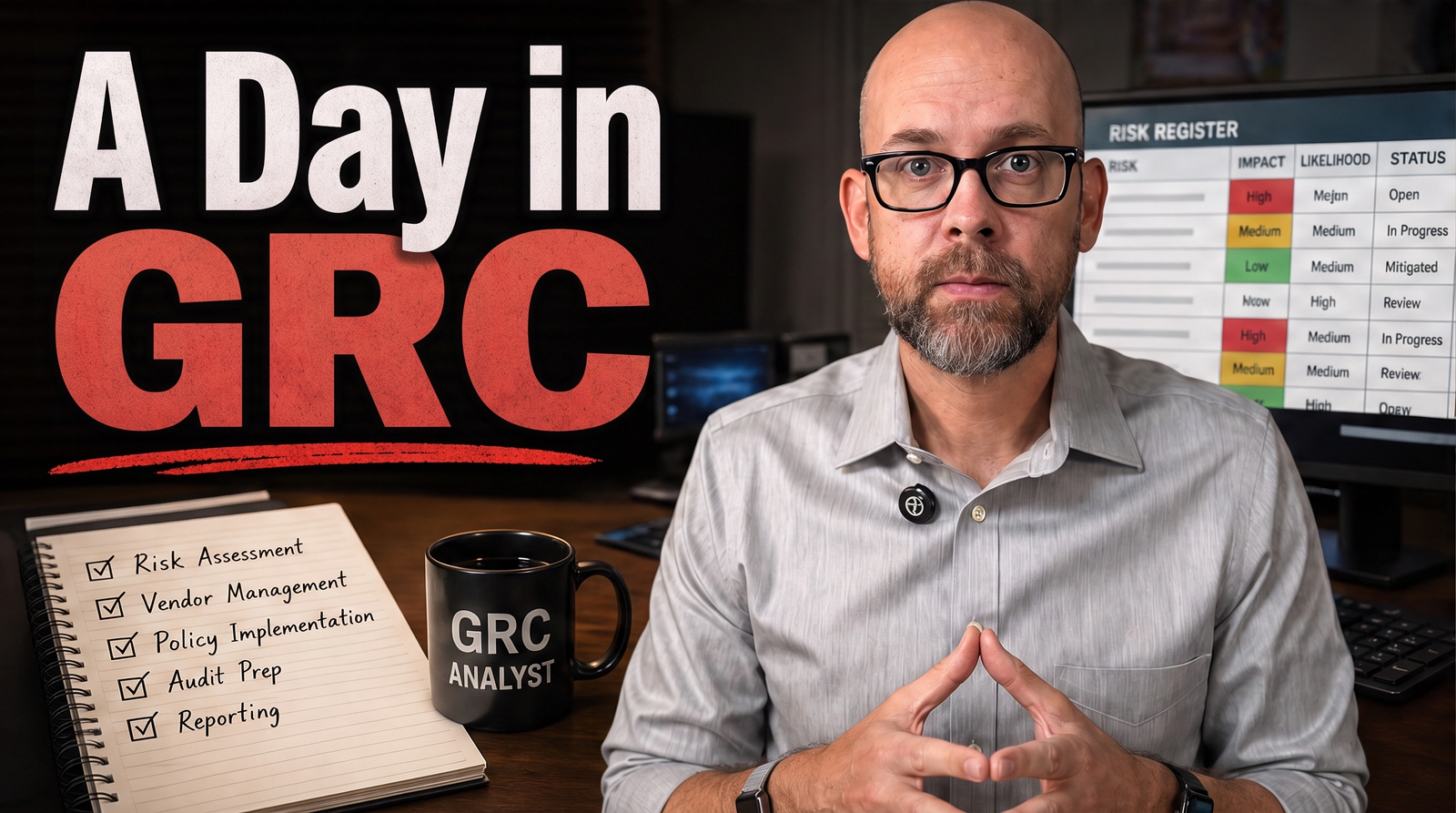
People looking at cybersecurity careers often hear that GRC is a good entry point, especially if you’re less interested in the deeply technical side. But when they ask what a GRC analyst actually does all day, the answers tend to be vague.
You hear about governance, risk, and compliance frameworks. You hear about policies and documentation. Maybe you hear it’s the business side of security.
None of that tells you what the work actually feels like or whether you’d be good at it.
The confusion makes sense. GRC sits at an unusual intersection in cybersecurity. It’s not security operations, where you’re monitoring alerts and responding to incidents. It’s not security engineering, where you’re building and configuring systems. It’s not penetration testing, where you’re actively breaking things to find vulnerabilities.
But it’s also not simply the nontechnical side of cybersecurity where you can work without understanding technology. That misconception causes problems for people entering the field and for organizations hiring GRC analysts who expect someone to just push paper.
The reality is more nuanced and, frankly, more interesting than either extreme suggests.
Prefer to read the full breakdown? Keep scrolling. Prefer to watch? Full video above.
What GRC Actually Means in Practice
Governance, risk, and compliance aren’t three separate jobs. They’re interconnected functions that organizations need to manage how security decisions get made, how risks get evaluated and treated, and how the organization demonstrates it meets various obligations.
A GRC analyst sits at the intersection of technology, business processes, risk management, and organizational decision-making.
The work requires translating between technical teams and business stakeholders while understanding enough about both domains to ask good questions, identify gaps, and communicate risk accurately.
Success depends less on configuring systems and more on understanding how systems, controls, people, and processes work together. That’s a different type of thinking than security operations or engineering requires, but it’s not easier or less important.
So what does this look like in practice? Let’s walk through the actual responsibilities.
Risk Assessments: Understanding Threats and Business Context
A significant portion of GRC work involves conducting or supporting risk assessments. This is not just filling out a risk matrix template or rating everything as “medium.”
A real risk assessment starts with understanding what assets the organization has that matter. That means talking to business process owners to understand how their systems work, what data they handle, who has access, and where dependencies exist.
You need to know enough about attack vectors to identify realistic threats. What could actually go wrong? How would an attacker approach this system? What happens if this data gets exposed or this process gets disrupted?
But you also need business context. A vulnerability that sounds critical in a textbook might be low risk in practice because of how the system is used, who can access it, or what compensating controls exist. Conversely, something that sounds minor might represent significant business risk because of regulatory requirements or competitive sensitivity.
The technical knowledge matters because you need to distinguish between theoretical risks and practical ones. If you can’t understand basic system architecture or data flows, you’ll identify risks that don’t exist and miss ones that do.
The assessment process involves reviewing documentation, interviewing stakeholders, sometimes observing processes firsthand, and making judgment calls about likelihood and impact based on incomplete information. You’re building a picture of where real vulnerabilities exist in workflows and what controls are feasible given operational constraints.
Then you document your findings in a way that helps decision-makers understand the risks and prioritize responses. That documentation needs to be specific enough to be useful but accessible enough that non-technical stakeholders can act on it.
Control Reviews and Evidence Collection: Validating That Security Works
When a GRC analyst reviews controls for an audit or assessment, they need to understand what the control is supposed to accomplish and whether the evidence actually demonstrates that it works.
Let’s say you’re reviewing access controls. The policy states that user access gets reviewed quarterly and inappropriate access gets removed. You receive a spreadsheet showing quarterly access reviews were completed.
Is that sufficient evidence? It depends.
You need to understand what the review process actually involved. Did someone look at each user’s access and validate it against their role? Or did managers just sign off on a list without really reviewing it? Does the evidence show that inappropriate access was actually identified and removed, or just that a meeting happened?
Looking at a firewall rule screenshot means nothing if you can’t read the configuration well enough to verify it matches the stated control. Reviewing access control logs requires understanding what normal versus anomalous patterns look like.
The analyst is not configuring these systems, but needs enough technical literacy to evaluate whether the control exists, operates as described, and would actually prevent or detect the risk it’s meant to address.
This work often feels tedious. You’re collecting documentation, reviewing configurations, checking logs, and validating that what’s supposed to happen is actually happening. But it matters because this is how you distinguish between security theater and actual security.
Organizations that treat this as checkbox compliance end up with controls that look good on paper but don’t work in practice. Effective GRC analysts prevent that by actually validating control effectiveness rather than just confirming documentation exists.
Vendor Risk and Third-Party Management: Translating Questionnaires into Decisions
Many GRC analysts spend significant time managing vendor risk. This typically involves security questionnaires, contract reviews, and third-party assessments.
The process looks straightforward. Send the vendor a security questionnaire. Review their responses. Make a risk decision.
In practice, it’s more complicated.
Vendors have strong incentives to make their security posture sound better than it is. You need to read responses critically and identify vague or incomplete answers. When a vendor says they have “appropriate security controls,” what does that actually mean? When they claim compliance with a framework, do they have third-party validation or is it self-assessed?
You need to understand what security controls vendors should have in place based on the type of data or access they’ll have. A vendor processing credit card data needs different controls than one shipping promotional materials. A vendor with network access to your environment needs different evaluation than one using a completely isolated SaaS platform.
The work involves following up on gaps, evaluating whether a vendor’s security posture is adequate for the specific risk they introduce, and helping the business make informed decisions about accepting, mitigating, or avoiding vendor-related risks.
Sometimes the answer is “this vendor’s security is weak, but the business need is critical, so we’ll implement additional monitoring and contractual requirements.” Sometimes it’s “the risk is too high for the value this vendor provides.”
You’re not making those decisions alone, but you’re providing the analysis that enables good decisions instead of blind ones.
Remediation Tracking and Stakeholder Communication: Connecting Findings to Action
After audits, assessments, or vulnerability scans identify gaps, someone needs to track remediation. That’s often a GRC analyst.
This involves working with technical teams to understand why findings exist, what it would take to fix them, whether compensating controls reduce the risk, and how to prioritize remediation when resources are limited.
The challenge is balancing urgency, feasibility, and competing priorities.
A finding might be legitimately difficult to remediate because it requires architectural changes or affects critical business processes. The technical team isn’t making excuses. The work is genuinely complex and time-consuming.
But you also encounter situations where findings sit unaddressed because no one is paying attention or because teams deprioritize security work when other demands arise.
The GRC analyst needs to understand the difference. That requires enough technical credibility to have honest conversations with engineering teams about what’s realistic and what’s avoidance. It also requires communication skills to escalate effectively when timelines slip and help leadership understand the risk of delayed fixes without creating panic.
You’re not performing the remediation yourself, but you need to track progress accurately, identify when issues need escalation, and translate technical remediation timelines into business terms that executives can use to make resource allocation decisions.
Policy Work and Framework Implementation: Connecting Requirements to Reality
GRC analysts often develop or maintain security policies, standards, and procedures. This sounds straightforward until you try it.
The challenge is writing requirements that are specific enough to be useful but flexible enough to work across different systems and business units.
A password policy that mandates specific technical requirements might work perfectly for corporate laptops but create problems for specialized industrial control systems or legacy applications that can’t support those requirements. A data classification policy needs to be clear enough that people can actually classify data correctly, not so complex that everyone ignores it.
You need to understand how technical teams will implement the policy, what’s realistic to enforce, what can be automated versus what requires manual processes, and how to measure compliance.
This requires moving between the abstract language of compliance frameworks and the concrete reality of how technology and people actually work.
If you write policies without understanding implementation constraints, you create compliance theater. The policy looks good, but no one follows it because it’s impractical, and no one can effectively measure compliance because the requirements can’t actually be validated.
Effective policy work requires technical literacy combined with business judgment and an understanding of organizational change management. You’re not just documenting what should happen. You’re creating requirements that can actually be implemented and measured.
Is GRC Right for You?
If you’re considering a GRC role, here’s what matters.
You need enough technical foundation to read configurations, understand basic networking and access controls, and follow technical conversations even if you’re not doing hands-on implementation. You don’t need to be a systems administrator, but you need technical literacy. Without it, you can’t evaluate whether controls actually work or communicate credibly with technical teams.
You also need to be comfortable with significant relationship management and communication. You’ll spend time in meetings with technical teams, business process owners, auditors, and executives. If you strongly prefer heads-down technical work with minimal collaboration, GRC may not be the right fit regardless of your technical skill level.
Understand that entry-level GRC roles often involve significant evidence collection, documentation, and coordination work that can feel repetitive. The strategic risk and governance work typically comes after you build credibility and understand how the organization works. Plan for this progression rather than expecting immediate high-level decision-making.
When evaluating opportunities, look for roles that include exposure to multiple functions like risk assessments, audit support, vendor risk, and policy work rather than positions focused only on compliance documentation. Broader experience helps you understand how the pieces connect and builds a stronger foundation for career growth.
Most importantly, develop judgment about what matters by understanding why controls exist, not just that they’re required. Learn to distinguish between controls that reduce real risk and controls that exist primarily for compliance checkbox purposes. This judgment is what makes a GRC analyst valuable beyond being a documentation coordinator.
Understanding Where You Fit
GRC work requires a different type of thinking than security operations or engineering, but it’s not simply the nontechnical side of cybersecurity.
The work creates value by connecting technical controls to business objectives, helping organizations make informed risk decisions, and preventing both over-investment in low-value controls and under-investment in critical ones.
If you enjoy work that sits between technical and business domains, if you’re good at asking questions that uncover gaps others miss, and if you can translate between different stakeholder groups, GRC might be a strong fit.
The field needs people who can do this work well. Organizations struggle when GRC becomes pure compliance theater disconnected from actual risk, and they struggle when security decisions get made without adequate business context.
Start building both technical literacy and communication skills. Understand common frameworks like NIST Cybersecurity Framework or ISO 27001 not by memorizing them, but by understanding what problems they’re trying to solve. Learn enough about how technology works to evaluate whether controls make sense.
The work matters. It just looks different than most people expect.
Tagged:
Enjoyed this article?
Subscribe to Professor Simon's weekly newsletter for practical insights, career guidance, and leadership lessons delivered every Friday.
A confirmation email will be sent. If you don't receive it, please check your spam or junk folder.
No spam. Unsubscribe anytime.
Prefer to Listen?
Listen to Professor Simon’s IT & Cybersecurity Podcast for practical conversations about cybersecurity careers, certifications, security leadership, and real-world lessons from the field.
Listen on Spotify