Shadow AI at Work: The Complete Guide to Unauthorized AI Tools and Governance
The notification arrives without warning: IT has flagged unauthorized software on your laptop. What felt like a harmless productivity shortcut, pasting a client email into ChatGPT to draft a faster reply, dropping a spreadsheet into an AI tool to summarize it, is suddenly a policy violation, and explaining it to your manager feels absurd. Nobody meant any harm. Nobody stole anything. And yet the exposure is real.
This is shadow AI: the use of AI tools at work without formal approval, review, or oversight from IT or security teams. It’s not new in spirit. Employees have always found workarounds, from forwarding files to personal email to installing unauthorized software. What’s different this time is the speed of adoption and the nature of what gets exposed. A forwarded spreadsheet is a contained, traceable event. A prompt typed into a public AI tool can leave the building instantly, get used to train someone else’s model, and never fully come back.
Shadow AI has become one of the most common, and most misunderstood, security risks in modern workplaces. This guide covers what it actually is, why it keeps happening even at security-conscious companies, what the real risks are, why most organizations still haven’t caught up with a policy, and what both employees and IT teams can do about it.
What Shadow AI Actually Is
Shadow AI describes any AI tool (a chatbot, a code assistant, an image generator, an AI-powered browser extension, an “AI meeting notes” add-on) used for work purposes without going through an organization’s approval, security review, or procurement process.
It shows up in ordinary moments, not dramatic ones:
- An employee pastes a client email into a public AI chatbot to draft a faster, more polished reply.
- A developer drops a chunk of proprietary code into an AI coding assistant to debug it quicker.
- A marketing team member uploads a customer list into an AI tool to generate personalized outreach copy.
- An analyst uploads an internal spreadsheet to have an AI tool summarize it for a meeting.
None of these people are trying to cause a breach. They’re trying to get their work done faster, which is exactly why shadow AI spreads so quickly and why banning it outright rarely works. The tools solve a real problem. The gap is that almost none of them come with a security review attached.
The scale is larger than most leadership teams assume. Estimates for how many employees use AI tools without formal approval run as high as the high-90th percentile at some organizations, meaning unofficial AI use, not the sanctioned enterprise tool, is often the default way work actually gets done. IT and security teams frequently have no idea which tools are in use, what data has been shared with them, or how many separate AI vendors now hold a copy of company information.
Why It’s Different From Old-Fashioned Shadow IT
Shadow IT (unauthorized software, personal cloud storage, unapproved apps) has existed for decades, and most security teams have a playbook for it. Shadow AI deserves separate attention for a few specific reasons:
Data doesn’t just move, it gets absorbed. Uploading a file to unauthorized cloud storage is a containment problem: find it, delete it, rotate any exposed credentials. Once text has been submitted to certain AI tools, depending on that provider’s data retention and training policies, it may be stored, reviewed by humans for quality purposes, or in some cases used to improve the underlying model. There often isn’t a clean way to “get it back.”
The barrier to entry is nearly zero. Old shadow IT usually required installing something, an action IT could sometimes detect. Most AI tools today just need a browser tab. No install, no admin permissions, no obvious footprint.
It touches every department, not just technical ones. Shadow IT tended to concentrate in engineering and IT-adjacent teams. Shadow AI shows up everywhere: HR drafting job descriptions, finance summarizing reports, sales personalizing outreach, support drafting responses to angry customers. The exposure surface is the entire company, not one department.
Supply chain risk compounds it. Security researchers have tracked a sharp rise in supply chain and third-party breaches over the past several years, as attackers increasingly target the “interconnected systems and trusted integrations” that sit between a company and its vendors. Every unauthorized AI tool an employee adopts is effectively a new, unvetted third-party integration, one procurement and security never got the chance to evaluate.
What’s Actually at Risk
It’s worth being concrete about what shadow AI puts in danger, because “security risk” is vague enough to ignore and specific enough to act on.
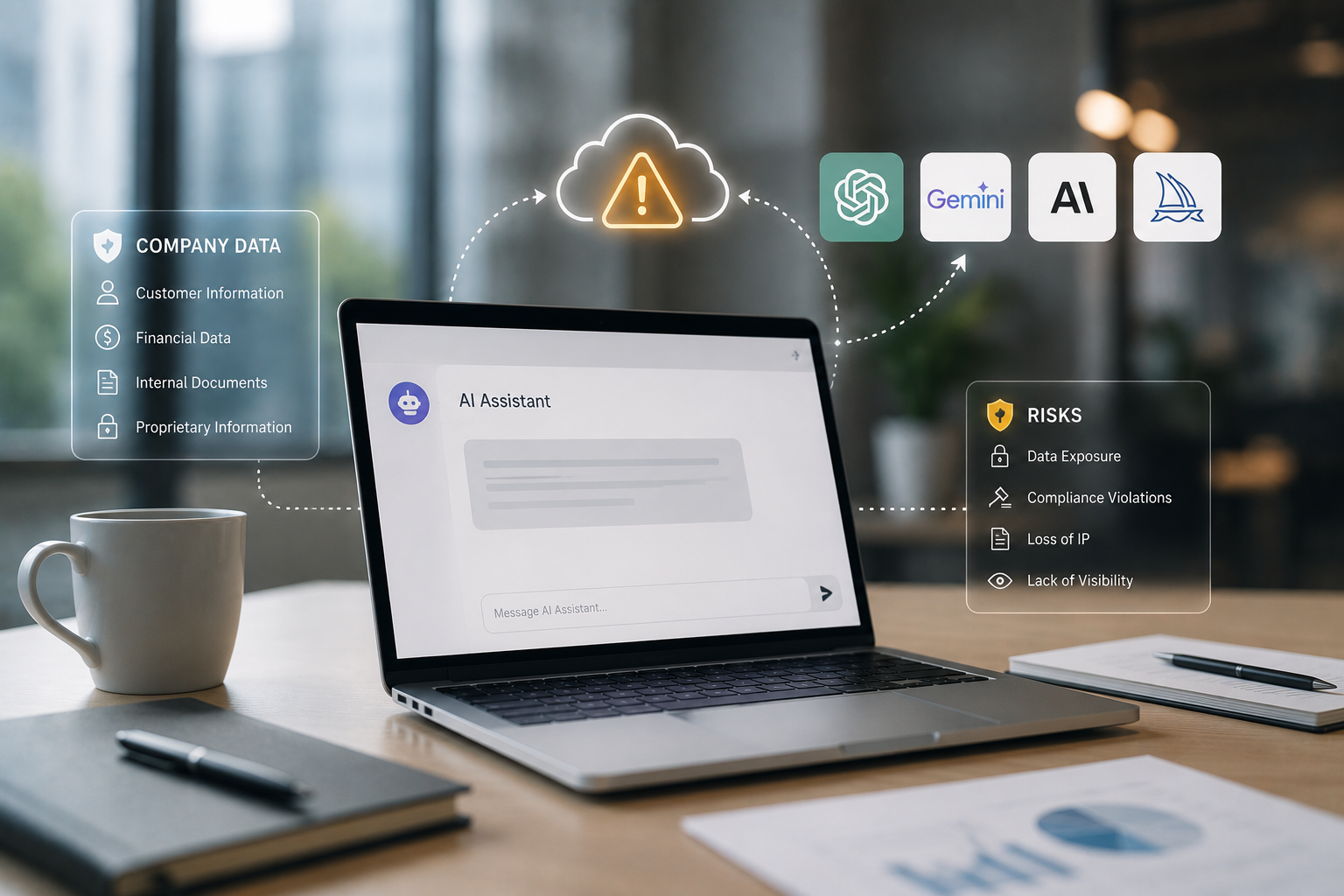
Confidential and regulated data leaving the organization. Customer PII, health information, financial records, or trade secrets typed into a public AI tool may now sit on servers the company doesn’t control, governed by terms of service most employees never read. For regulated industries (healthcare, finance, legal) this alone can trigger compliance violations independent of whether any breach ever occurs.
Intellectual property exposure. Proprietary source code, unreleased product plans, or internal strategy documents pasted into an AI assistant for “just a quick check” may be retained by the vendor, reviewed by their staff, or in some tool configurations, incorporated into future model training.
No audit trail. When a security incident happens through an approved system, there are logs of who accessed what, when. Shadow AI usage typically leaves none of that. If sensitive data leaks and shadow AI was the vector, most organizations can’t even determine what was exposed or when.
Cost when it goes wrong. Breaches that involve unmanaged or unauthorized tools carry meaningfully higher remediation costs than breaches through sanctioned, monitored systems. The absence of visibility and audit trails makes containment slower and more expensive.
Career and trust fallout for the employee, not just the company. The person who pasted a client’s contract into an AI tool to “just summarize it” didn’t intend harm, but they may still be the one explaining the incident afterward. Understanding this risk protects individual employees as much as it protects the organization.
The Governance Gap: Why Most Companies Still Don’t Have a Policy
Here’s the uncomfortable part: this isn’t a niche problem at unprepared companies. Recent research from multiple sources, including surveys from Gallup, KPMG, and Tech.co, consistently finds that roughly six in ten organizations have no formal AI governance policy, even as a large majority of them are actively using generative AI in daily operations. The adoption curve and the governance curve are badly out of sync, and the gap between them is exactly where shadow AI thrives.
A few reasons this gap persists even at otherwise well-run companies:
Leadership assumes IT already has it covered. IT assumes business units are managing their own tool adoption. Nobody owns the policy because everybody assumes someone else does.
AI moved faster than procurement. Traditional software procurement (security review, legal review, vendor risk assessment) was built for purchases that took months. AI tools can be adopted by an individual employee in minutes, with no purchase order at all.
Policy feels like it will slow people down. Leadership worries that a strict AI policy will frustrate employees or put the company at a competitive disadvantage against faster-moving competitors. This fear is understandable, but it usually produces the opposite of the intended outcome: banning AI outright just pushes usage further underground, where there’s even less visibility into what’s happening.
Nobody has been through an incident yet. Many governance programs, for AI and otherwise, get built reactively, after something goes wrong, not before. Waiting for that moment with AI tools is a considerably more expensive way to learn the lesson.
Building an AI Governance Policy That Employees Will Actually Follow
A workable AI governance policy isn’t a 40-page legal document nobody reads. It answers a small number of practical questions clearly enough that an employee can make the right call in the moment.
1. Name the approved tools. Give employees at least one sanctioned AI tool for common tasks (drafting, summarizing, coding assistance) with a vendor whose data handling and retention terms have actually been reviewed. An approved option is the single most effective way to reduce shadow AI, because it replaces “use nothing” with “use this instead.”
2. Define what can and can’t go into any AI tool, approved or not. This is the single highest-leverage rule in the whole policy. Spell out concrete categories: customer PII, health records, financial data, unreleased product information, source code, anything under an NDA. Employees generally aren’t trying to violate policy; they usually don’t know where the line is until someone draws it.
3. Make the approval process fast. If getting a new AI tool evaluated takes eight weeks, employees will use an unapproved one in the meantime. A lightweight intake process, even a simple form reviewed within a few business days, keeps people inside the guardrails instead of routing around them.
4. Assign clear ownership. Someone specific, not “IT” as an abstraction, needs to own AI governance: reviewing new tool requests, updating the approved list, and answering questions. Diffuse ownership is how gaps like this persist for years.
5. Train for judgment, not memorization. Nobody remembers a bulleted policy list under deadline pressure. What sticks is a habit: before pasting something into an AI tool, ask “would I be comfortable if this data left the building right now?” That single question catches most of the risk.
6. Revisit the policy on a real cadence. AI tools and their data-handling terms change quickly. A policy written a year ago may already be out of date. Treat it as a living document with a scheduled review, not a one-time project.
What This Means If You’re the Employee, Not the Policy Writer
If you’re reading this as an individual contributor rather than someone setting company policy, the practical guidance is simpler than it looks:
- Ask before assuming. If your company hasn’t published an AI policy, ask what’s approved rather than guessing. It’s a five-minute conversation that protects you specifically.
- Treat AI tools like you’d treat a external contractor with no NDA. Would you hand this data to a stranger with no confidentiality agreement? If not, don’t paste it into a tool whose data policy you haven’t read.
- Understand why the restrictions exist. A blocked AI tool on your work laptop isn’t arbitrary friction. It’s usually a specific response to a specific risk category. Knowing the “why” makes the rule easier to work with instead of around.
- Use approved alternatives when they exist. If your company offers a sanctioned AI tool, default to it even when an unapproved one seems marginally more capable. The productivity gap is rarely worth the exposure.
- When in doubt, ask security before you paste, not after. The five minutes it takes to check is dramatically cheaper than the aftermath of a data exposure incident, for the company, and for your own standing.
The Bottom Line
Shadow AI isn’t a story about reckless employees or a technology that needs to be banned. It’s a predictable outcome of powerful, easy-to-access tools arriving faster than the governance structures meant to manage them. The organizations getting this right aren’t the ones with the strictest bans. They’re the ones that gave employees a fast, sanctioned way to get the same productivity benefit, drew a clear line around what data can never leave the building, and made both of those things easy to know and easy to follow.
If your organization doesn’t have an AI policy yet, that gap is worth raising, not as a compliance exercise, but as the fastest way to close the distance between how your company actually works today and how well it’s protected.
Enjoyed this article?
Subscribe to Professor Simon's weekly newsletter for practical insights, career guidance, and leadership lessons delivered every Friday.
A confirmation email will be sent. If you don't receive it, please check your spam or junk folder.
No spam. Unsubscribe anytime.
Prefer to Listen?
Listen to Professor Simon’s IT & Cybersecurity Podcast for practical conversations about cybersecurity careers, certifications, security leadership, and real-world lessons from the field.
Listen on Spotify