What Does an Entry-Level Cybersecurity Resume Actually Need?
You have read the advice. Get certifications. Build a home lab. List every tool you have touched. Include all the frameworks. Add keywords to beat the automated systems. The result is a resume packed with acronyms, certification logos, and skills lists that span half a page.
Then you submit it and hear nothing back.
The problem is not that you lack qualifications. The problem is that most resume advice treats keyword volume as proof of competence. It assumes that listing more technologies, more certifications, and more frameworks makes you appear more qualified.
That assumption breaks down the moment a hiring manager reviews your resume.
An effective entry-level cybersecurity resume does not try to prove you know everything about security. It provides credible evidence of foundational capabilities, relevant experience, and alignment with a specific role. The resume should make it easy for a hiring manager to identify what you can actually do and discuss in an interview.
Prefer to read the full breakdown? Keep scrolling. Prefer to watch? Full video above.
The Problem with Following All the Resume Advice
Career changers and students entering cybersecurity face an overwhelming amount of conflicting guidance. Some sources emphasize certifications. Others focus on home labs. Some recommend listing every security framework you have studied. Others suggest tailoring everything to specific job descriptions.
The natural response is to include everything. If you are uncertain which elements matter, adding all of them seems safer than leaving something out.
This creates resumes that pass automated screening systems by matching keywords but fail to convince hiring managers during the human review. The resume demonstrates breadth of exposure but provides little evidence of actual capability.
More content does not translate to more credibility. A resume filled with items you cannot discuss effectively in an interview undermines your credibility rather than building it.
What Hiring Managers Actually Look For
When a hiring manager reviews an entry-level cybersecurity resume, they spend perhaps thirty seconds making an initial determination. They are not reading every line. They are scanning for evidence that answers three questions:
Does this candidate have relevant technical foundations? Can this candidate actually do the work we need? Is there enough here to justify spending time in an interview?
They are looking for credible evidence, not keyword density.
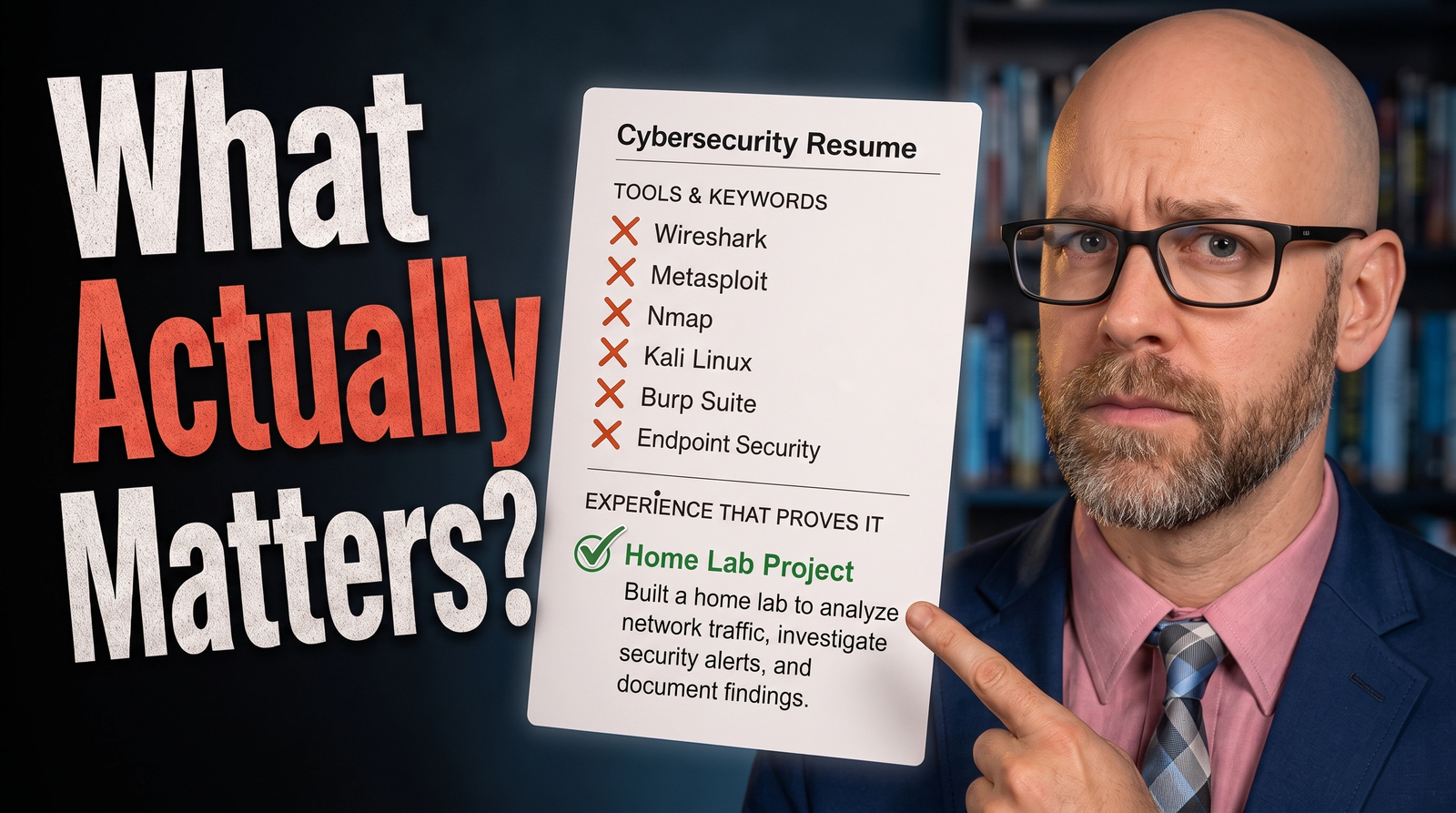
A long list of tools or certifications without context raises questions about depth of knowledge. If you list Wireshark, Nmap, Metasploit, Burp Suite, Nessus, Splunk, and ten other tools, the hiring manager wonders whether you have meaningful experience with any of them or whether you are listing everything mentioned in your coursework.
The challenge is not to appear knowledgeable about everything. The challenge is to provide evidence of capabilities relevant to the specific role you are pursuing.
Transferable IT Experience Matters More Than You Think
Many candidates emphasize security concepts they learned in courses while undervaluing practical IT experience. This is a significant mistake.
Troubleshooting network connectivity issues teaches you how TCP/IP actually works in production environments. Managing user accounts and permissions demonstrates understanding of access control in practice. Documenting system configurations shows attention to detail and professional discipline. Supporting applications exposes you to how systems interact and where problems occur.
Hiring managers recognize that someone who has worked in IT understands how systems actually operate. That matters more than someone who can list security frameworks but has never supported real infrastructure.
If you have help desk experience, you have worked with ticketing systems, followed processes, communicated with users, and solved problems under time pressure. If you have done desktop support, you understand endpoints, software deployment, and troubleshooting methodology. If you have worked in network or system administration, you have configured actual infrastructure that people depend on.
This experience demonstrates technical competence and professional behavior that translates directly to security work. A security analyst needs to understand how the systems they are protecting actually function. Someone with IT experience already has that foundation.
Your resume should highlight IT experience that demonstrates relevant technical skills, problem-solving ability, and exposure to the technologies the security team protects. Do not bury this experience beneath generic security terminology.
How to Present Projects That Demonstrate Capability
Listing a home lab or capstone project without explaining what was built, what problems were solved, or what was learned provides no evidence of competence.
A single line that says “Built home lab environment” tells a hiring manager nothing. They cannot evaluate capability from that statement. They do not know what technologies you used, what you configured, what challenges you encountered, or what you learned.
Compare these two approaches:
Generic: “Created home lab to practice cybersecurity skills”
Detailed: “Built virtualized network environment using VMware ESXi with Windows Server 2019 domain controller, Windows 10 clients, pfSense firewall, and Security Onion IDS. Configured VLANs to segment traffic, deployed Sysmon for endpoint logging, and practiced detecting common attack patterns including credential dumping and lateral movement. Documented configurations and wrote procedures for rebuilding the environment.”
The detailed version allows a hiring manager to assess whether the project demonstrates relevant skills. It provides specific discussion points for an interview. It shows that you understand what you accomplished and can articulate what you learned.
This level of detail matters for any project you include. Describe what technologies were used. Explain what was configured or analyzed. Identify what challenges were encountered and how you addressed them. State what you learned from the experience.
Generic project descriptions suggest you do not understand what you actually accomplished. Detailed descriptions demonstrate competence and give the hiring manager confidence that you can discuss your work meaningfully.
The Right Way to Think About Certifications
Certification logos and acronyms fill space without demonstrating knowledge. The value of a certification depends on whether it is relevant to the position and whether you retained enough understanding to discuss it meaningfully.
A Security+ certification matters for roles that require it or value foundational knowledge. It demonstrates that you understand basic security concepts and can discuss them coherently. If you earned it recently and can still explain the content, it provides credible evidence of foundational knowledge.
A CISSP listed by a candidate with no qualifying experience raises credibility questions. The certification requires five years of relevant work experience. If you do not have that experience, listing the certification suggests you do not understand its requirements or are attempting to misrepresent your qualifications.
Multiple certifications in unrelated areas suggest you are collecting credentials rather than building expertise. If you list Network+, Security+, CySA+, PenTest+, Cloud+, and Linux+ all earned within six months, a hiring manager questions how much you actually retained from any of them.
Include certifications that align with the target role and that you are prepared to discuss in an interview. If you cannot explain key concepts from a certification you listed, do not include it. The certification should demonstrate relevant knowledge, not just test-taking ability.
Why Your Tool List Might Be Hurting Your Credibility
Long lists of security tools, programming languages, and technologies often include items you have only read about or encountered briefly in a course. This creates a credibility problem during interviews.
When a hiring manager asks about your experience with a tool you listed and you explain that you used it once in a lab exercise, they begin questioning everything else on your resume. If you cannot discuss how you used the technology or what you learned from it, why is it on your resume?
The standard should be whether you can explain what you did with the technology and what you learned from the experience. If someone asks about Python on your resume, can you describe scripts you have written and problems you have solved? If someone asks about Wireshark, can you explain what traffic you have analyzed and what you were looking for?
A shorter list of technologies you have used meaningfully is more valuable than a comprehensive inventory of every tool mentioned in your coursework.
Review your technical skills section with this question: For each item listed, can I have a three-minute conversation about how I used it and what I learned? If the answer is no, remove it.
Accomplishments Over Responsibilities
Many resumes list job responsibilities or course requirements instead of accomplishments. This pattern provides no evidence of capability.
Saying you were responsible for monitoring security alerts does not demonstrate that you can analyze alerts effectively. Saying you completed coursework in incident response does not show that you can work through an actual incident.
Describing a specific situation where you identified a misconfiguration, resolved a technical issue, improved a process, or solved a problem provides evidence of how you think and work.
Even small accomplishments matter. If you identified a recurring help desk ticket pattern and documented a solution that reduced similar tickets, that demonstrates analytical thinking and initiative. If you found and reported a security misconfiguration during an internship, that shows security awareness applied to real systems. If you automated a manual process using a script, that demonstrates technical problem-solving.
Focus on situations where you identified a problem, determined a solution, took action, and achieved a result. These accomplishments demonstrate capabilities that matter in security work: analytical thinking, technical troubleshooting, attention to detail, and the ability to deliver results.
For each position or project on your resume, identify at least one specific accomplishment rather than simply listing duties.
Putting It Together: The Resume Review Process
Start with the job description for the position you are pursuing. Identify the core technical requirements, not just keywords. Determine which elements of your background provide evidence you can meet those requirements.
Review each section of your resume from the perspective of a hiring manager who will spend thirty seconds deciding whether to interview you. Can they quickly identify relevant technical foundations, evidence of capability, and alignment with the role?
For each technical skill, tool, or technology listed, prepare to explain what you did with it and what you learned. If you cannot discuss it meaningfully in an interview, remove it.
For each project, verify that the description includes enough detail that a hiring manager can understand what you built, what problems you solved, or what you learned. Generic project descriptions should be expanded or removed.
For each certification, confirm that it aligns with the target role and that you can discuss the content. Certifications that do not meet this standard should be reconsidered.
For each position or project, confirm that you have described specific accomplishments rather than just responsibilities or activities.
The goal is not to create the longest resume or to include everything you have ever done. The goal is to make it easy for a hiring manager to identify relevant qualifications and determine that you are worth interviewing.
A resume that requires careful reading to find relevant qualifications needs revision. The relevant evidence should be immediately apparent.
What This Means for Your Resume
An effective entry-level cybersecurity resume prioritizes credible evidence over keyword volume. It highlights transferable IT experience, describes projects with sufficient detail to demonstrate capability, includes certifications that align with the role, lists only technologies you can discuss meaningfully, and focuses on accomplishments rather than responsibilities.
This approach requires more thought than simply listing everything possible. You must evaluate each element and determine whether it provides evidence of relevant capability or simply adds noise.
The result is a resume that makes it easy for a hiring manager to understand what you can actually do. That is what gets you the interview.
Review your resume using the framework provided here. Identify one element that adds noise rather than evidence and revise or remove it. Then identify one area where you can add detail that demonstrates capability.
Your resume should make the hiring manager want to have a conversation with you about your experience and capabilities. Everything else is noise.
Tagged:
Enjoyed this article?
Subscribe to Professor Simon's weekly newsletter for practical insights, career guidance, and leadership lessons delivered every Friday.
A confirmation email will be sent. If you don't receive it, please check your spam or junk folder.
No spam. Unsubscribe anytime.
Prefer to Listen?
Listen to Professor Simon’s IT & Cybersecurity Podcast for practical conversations about cybersecurity careers, certifications, security leadership, and real-world lessons from the field.
Listen on Spotify