Supply Chain Security: Why Your Vendors Are Your Risk
A heating and air conditioning contractor became the entry point for one of the largest data breaches in retail history. In 2013, attackers stole network credentials from Target’s HVAC vendor and used them to access the retailer’s internal systems, ultimately compromising 40 million credit card numbers and 70 million customer records. Target didn’t get breached because of a flaw in its own security. It got breached because a vendor with legitimate network access had weaker security than Target did.
This is supply chain security in its most concrete form: your organization’s security posture isn’t just about your own systems. It’s about every vendor, contractor, and third party with access to your network, your data, or your customers. Every business today relies on external vendors. Payroll processors handle employee banking details, email marketing platforms store customer contact lists, and cloud storage providers host sensitive documents. These relationships streamline operations and reduce costs, but they also create security exposure that many organizations never formally assess.
Why This Isn’t Just a Big-Company Problem
Supply chain security sounds like a concern reserved for Fortune 500 companies and government agencies. That assumption puts small and mid-sized businesses at real risk. Attackers frequently target smaller organizations precisely because they serve as entry points to larger networks, exactly the pattern that played out in the Target breach. A small vendor with weak security, serving multiple larger clients, represents an efficient target: compromise one vendor, potentially gain access to several downstream organizations through the same weakness.
Smaller businesses often assume they’re too insignificant to be a deliberate target, which is exactly the assumption that makes them attractive as a stepping stone. If your business has any vendor relationship involving system access, data sharing, or network connectivity, supply chain security applies to you regardless of your size.
The Scale of the Exposure
Organizations manage far more third-party relationships than most people realize, and that number keeps growing. Recent industry data puts the average company at close to 300 active third-party vendor relationships, a meaningful increase over just the past couple of years, while the security teams responsible for assessing and monitoring those relationships often haven’t grown to match. A significant share of third-party risk management programs operate with minimal dedicated staffing relative to the number of vendor relationships they’re responsible for overseeing.
This mismatch, rapidly growing vendor ecosystems paired with flat or shrinking oversight capacity, is exactly where supply chain risk accumulates unnoticed. Every new vendor relationship (a marketing platform, a payroll processor, a cloud storage provider, a contractor with remote access) adds another potential path into your systems, and without a deliberate process, most organizations have no clear picture of how many such paths actually exist.
What Actually Creates the Risk
Third-party vendor relationships create security exposure through a few consistent patterns worth understanding specifically.
Direct network or system access. Vendors who need remote access to perform their work, an HVAC contractor monitoring building systems, an IT managed service provider with administrative credentials, a software vendor with support access, inherit a level of trust in your network that your own security controls may not fully account for.
Data sharing without matching protection. Payroll processors, marketing platforms, and cloud storage providers all hold copies of sensitive data outside your direct control. Their data protection practices become your data protection practices in practice, whether or not you’ve formally verified them.
Software supply chain dependencies. Applications and services your organization relies on are themselves built on other vendors’ code, libraries, and infrastructure. A vulnerability introduced anywhere in that chain, even several layers removed from your direct vendor relationship, can eventually affect you.
Inconsistent vetting across vendor size and relationship length. Long-standing vendor relationships often escape the same scrutiny newer ones receive, on the assumption that an established relationship implies established security. That assumption isn’t reliable; a vendor’s security posture can change, or may never have been properly assessed in the first place.
Building a Practical Vendor Risk Program
Effective third-party risk management doesn’t require an enterprise-scale security team. It requires a consistent process applied to every vendor relationship that involves meaningful access or data sharing.
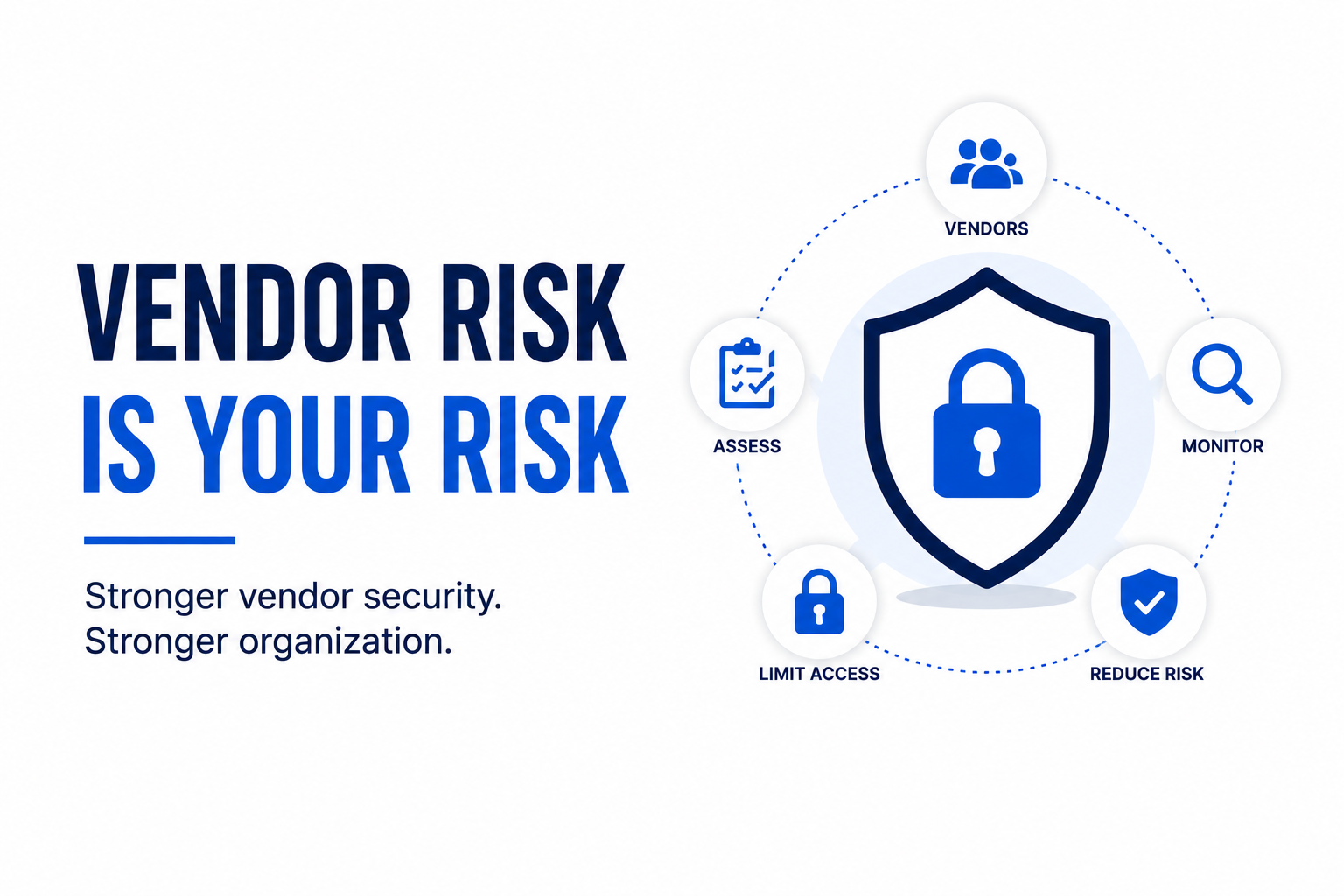
Inventory your actual vendor relationships first. Most organizations, especially smaller ones, don’t have a complete list of every third party with system access or data access. Building that inventory, however incomplete it feels initially, is the necessary starting point; you can’t assess risk you haven’t identified.
Tier vendors by actual risk exposure, not by size or spend. A small vendor with direct network access represents more risk than a large vendor with no system access at all. Categorize relationships by what access or data they actually have, then apply proportionally more scrutiny to higher-risk tiers rather than treating every vendor identically.
Ask for evidence, not just assurances. Security questionnaires, documentation of relevant certifications, or evidence of security practices give you something concrete to evaluate, rather than relying on a vendor’s verbal assurance that “security is a priority.” For higher-risk vendors, this evidence review should happen before the relationship begins, not after.
Limit access to what’s actually necessary. The same least-privilege principle that applies to internal accounts applies to vendor access: a vendor needing to update one system shouldn’t have broad network access “for convenience.” Scoping vendor access tightly limits the damage if that vendor’s own security fails.
Build review into the relationship’s lifecycle, not just onboarding. Vendor risk isn’t static. Reassessing key vendor relationships periodically, and specifically when a vendor’s role or access changes, catches risk that accumulates gradually rather than only at the start of the relationship.
Have a plan for vendor-originated incidents specifically. Your incident response plan should explicitly address the scenario where a breach originates from a vendor rather than your own systems, since the response (containing vendor access, verifying the scope of what that vendor could reach, coordinating with a third party you don’t directly control) differs meaningfully from a purely internal incident.
Reducing Risk Without Slowing the Business Down
A common concern with formalizing vendor risk management is that it will create friction: slower vendor onboarding, more bureaucracy, frustrated business units who just want to start working with a new tool or partner. This tension is real, but it’s manageable with the right approach.
Tiering vendors by actual risk, rather than applying the same heavyweight review to every relationship, keeps the process proportional. A low-risk vendor with no system access and no sensitive data exposure can move through a lightweight review quickly. A high-risk vendor with deep system access warrants a more thorough process, and that’s an appropriate tradeoff, not unnecessary friction.
Framing vendor risk management as protecting the business relationship, not obstructing it, also matters. A security team that shows up only to block a new vendor relationship builds resentment and gets routed around. A security team that helps business units choose lower-risk vendors, or helps negotiate better security terms with a vendor the business already wants, becomes a genuine partner in the decision rather than an obstacle to it.
Why This Skill Matters for Your Career, Not Just Your Organization
Vendor and third-party risk management has become a skill set that shows up in job descriptions well beyond purchasing and procurement departments. IT, legal, operations, and finance roles increasingly expect at least a working understanding of how vendor relationships create risk and how to evaluate them, reflecting how central third-party relationships have become to how modern organizations actually operate.
For anyone building a career in security, risk management, or IT more broadly, understanding vendor risk assessment isn’t a niche specialization. It’s an increasingly expected baseline competency, and one that transfers directly across governance, risk and compliance roles, security operations, and even general IT positions that touch vendor relationships in any capacity. Being able to speak concretely about how you’d assess a vendor relationship, what questions you’d ask, and how you’d tier risk is a genuinely useful thing to be able to discuss in an interview, regardless of the specific role you’re targeting.
The Bottom Line
Your organization’s security is only as strong as the weakest vendor with access to your systems or data. That’s not a hypothetical; it’s the exact mechanism behind some of the most damaging breaches in recent history. Building a proportional, consistently applied vendor risk process, one that scales scrutiny to actual risk rather than treating every relationship identically, closes off one of the most consistently underestimated paths attackers use to get in.
Enjoyed this article?
Subscribe to Professor Simon's weekly newsletter for practical insights, career guidance, and leadership lessons delivered every Friday.
A confirmation email will be sent. If you don't receive it, please check your spam or junk folder.
No spam. Unsubscribe anytime.
Prefer to Listen?
Listen to Professor Simon’s IT & Cybersecurity Podcast for practical conversations about cybersecurity careers, certifications, security leadership, and real-world lessons from the field.
Listen on Spotify