How to Choose Your First Cybersecurity Certification
Selecting a first cybersecurity certification can feel like navigating a minefield. CompTIA Security+, ISC2 SSCP, various cloud security credentials, and dozens of other options all claim to be the ideal starting point. For someone new to the field, this abundance creates paralysis rather than clarity, and the wrong choice wastes real time and money before you’ve even landed a first role.
This guide covers how to actually choose, what a certification can and can’t do for your job search, and the skills gap that catches people who treat certification collecting as a complete career strategy on its own.
What a Certification Actually Does for You
Before comparing specific credentials, it helps to understand precisely what a certification accomplishes, because overestimating its role is the single most common mistake in this decision.
A certification demonstrates that you’ve learned a defined body of foundational knowledge and can pass a standardized exam on it. Hiring managers and applicant tracking systems use certifications as an initial filter, especially for entry-level roles where a candidate has little else to show. In that narrow sense, the right certification genuinely opens doors that stay closed without one.
What a certification does not do: prove you can actually perform the job. Passing a multiple-choice exam demonstrates knowledge retention, not practical capability, problem-solving under pressure, or the judgment that comes from hands-on experience. This distinction matters enormously for how you plan your first year in the field, covered in more depth below.
Comparing the Common First Certifications
CompTIA Security+ remains the most broadly recognized entry-level certification and the most common baseline requirement in entry-level job postings, particularly for SOC analyst and general security analyst roles. It covers foundational security concepts across a wide range of domains without requiring deep prior IT experience. For most people entering the field without a strong existing technical background, this is the most defensible first choice: broad recognition, manageable difficulty, and direct relevance to the roles most beginners actually apply for.
ISC2’s Systems Security Certified Practitioner (SSCP) covers similar foundational ground with a slightly more technical, operations-focused lean. It’s a reasonable alternative for people who already have some IT experience and want a credential slightly more oriented toward hands-on security operations.
Cloud-specific certifications (from AWS, Microsoft Azure, or Google Cloud) make sense as a second certification once you’ve decided cloud security specifically is where you want to head, not as a first credential. Cloud security roles increasingly expect foundational cloud platform knowledge on top of general security fundamentals, and jumping straight to a cloud-specific credential without that foundation often means studying concepts in isolation without the security context that makes them useful.
Vendor-specific and advanced certifications (penetration testing credentials, advanced cloud security specialties, and similar) are not first certifications regardless of how they’re marketed. They generally assume foundational knowledge and, often, some real hands-on experience. Pursuing one of these before you have either tends to produce a credential you can list but can’t yet speak to convincingly in an interview.
The Decision Framework
Rather than researching every available option, narrow the decision with a few direct questions:
What roles are you actually targeting? Look at ten to fifteen real job postings for the specific entry-level role you want. Which certification appears most consistently as a requirement or preference? That real-world signal matters more than any ranked “best certifications” list, because it reflects what your actual target employers are screening for right now.
What’s your current technical background? Someone coming from an unrelated field benefits from a genuinely foundational certification (Security+ is the standard default). Someone with existing IT experience, help desk work, or system administration background can reasonably consider a credential with a slightly higher starting bar.
How much time and money can you realistically commit? Broad, foundational certifications typically require less study time and lower cost than specialized ones. If your runway is limited, that’s a legitimate factor in choosing the credential you can actually complete and afford, not just the one that looks most impressive.
Does the certification align with a specialization you’re actually interested in, or are you chasing a credential because it’s popular? A cloud security certification pursued because “cloud is where the money is,” with no genuine interest in cloud security work, tends to produce weaker interview performance than a foundational certification paired with real curiosity about the underlying material.
The Skills Gap That Certification Stacking Doesn’t Fix
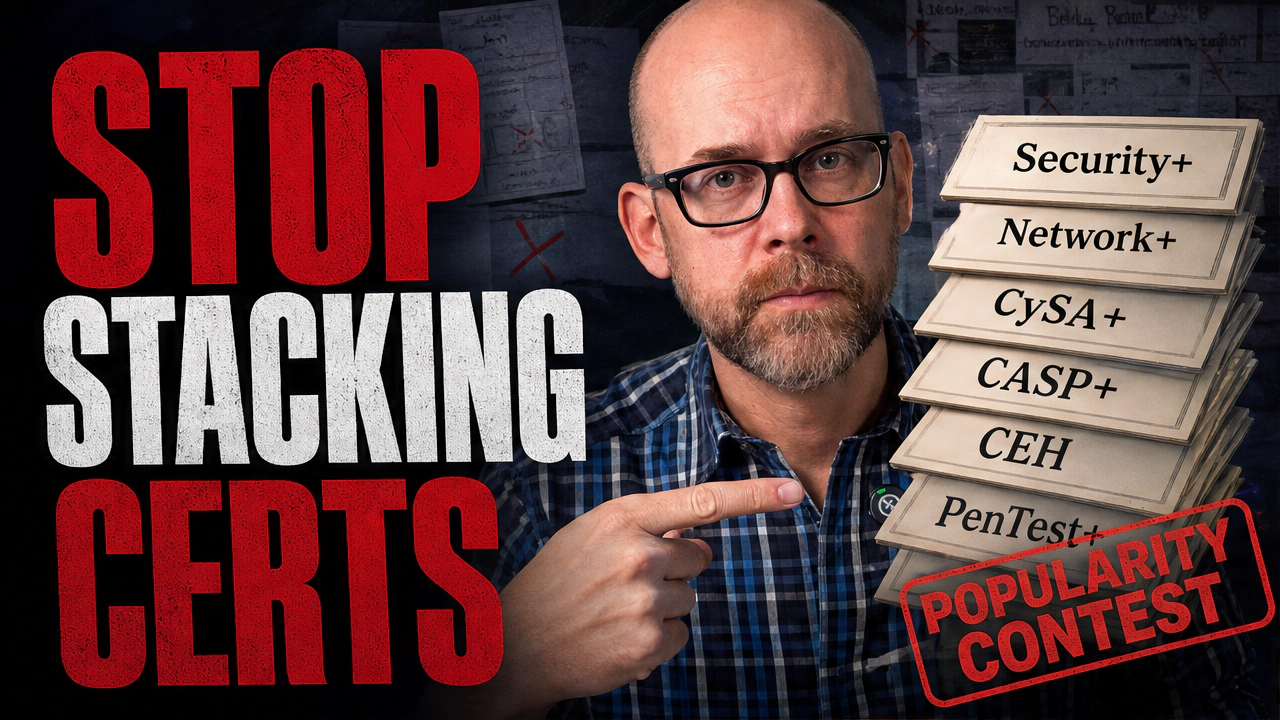
Certification stacking has become a default strategy for many people breaking into cybersecurity: earn Security+, add a second certification, maybe a third, and wait for offers to arrive. This approach consistently underperforms expectations, and understanding why matters as much as picking the right first credential.
Hiring managers increasingly encounter candidates with multiple certifications but no demonstrable hands-on experience: no home lab projects, no documented practice investigations, nothing beyond the credentials themselves. This profile raises a real concern during interviews, because certifications validate that you can pass an exam, not that you can troubleshoot an actual system, investigate a real alert, or explain your reasoning through an unfamiliar problem.
The pattern shows up clearly in technical interviews. Candidates with strong certification profiles but no practical grounding often struggle with scenario-based questions: asked to walk through how they’d investigate a specific type of alert, or explain a basic troubleshooting approach, they can recite definitions but can’t demonstrate the reasoning a working analyst uses daily. This gap is exactly what separates candidates who get offers from candidates who pass initial screening but stall out afterward.
The fix isn’t avoiding certifications. It’s treating a single well-chosen certification as one part of a broader preparation strategy, paired from the start with hands-on practice: a home lab, structured practice platforms, documented investigation exercises. Certification plus demonstrable practice consistently outperforms certification stacking alone, both in interviews and in actual job readiness once hired.
Is Getting a Certification Worth It At All?
For nearly everyone targeting entry-level roles without an existing technical background, yes, a foundational certification is worth the investment, largely because it remains the most common explicit requirement in entry-level postings and the fastest way to signal baseline knowledge to an unfamiliar hiring manager.
The more useful question isn’t whether to get a certification, but whether you’re treating it as the whole strategy or as one component of a broader one. Certification alone, without any hands-on practice to back it up, produces a credential that opens fewer doors than expected and closes uncomfortably in technical interviews. Certification paired with genuine hands-on practice, even modest, self-directed practice, produces a candidate who can back up the credential with real reasoning.
A Practical Starting Sequence
For most people entering the field without a strong existing technical background: start with CompTIA Security+ as your foundational certification. While studying for it, build a simple home lab and work through basic hands-on exercises in parallel, rather than treating study and practice as sequential phases. Apply to entry-level roles once you have the certification and at least a small amount of documented hands-on work you can discuss concretely in an interview. Choose a second, more specialized certification only after you’ve identified, through actual exposure to the field, which specialization genuinely interests you, rather than choosing it in advance based on salary headlines alone.
This sequence takes longer than simply collecting certifications as fast as possible. It also produces a substantially stronger candidate, and a person genuinely more prepared for the job once they get it.
Enjoyed this article?
Subscribe to Professor Simon's weekly newsletter for practical insights, career guidance, and leadership lessons delivered every Friday.
A confirmation email will be sent. If you don't receive it, please check your spam or junk folder.
No spam. Unsubscribe anytime.
Prefer to Listen?
Listen to Professor Simon’s IT & Cybersecurity Podcast for practical conversations about cybersecurity careers, certifications, security leadership, and real-world lessons from the field.
Listen on Spotify