How to Change Your IT Career Direction Without Starting Over
If you have a few years of IT experience and you are thinking about moving into cybersecurity, cloud, GRC, or another specialization, you probably assume you need to start over. That assumption costs people years of progress.
Most career changes in IT are not about starting from scratch. They are about recognizing what transfers and filling specific gaps. The question is not whether you are ready to begin again. The question is what you already bring and how much additional preparation you actually need.
I have watched experienced IT professionals delay career moves for years because they focused entirely on what they did not know about a new field rather than evaluating what they already brought to it. They assumed that changing from system administration to cloud engineering or from help desk to cybersecurity meant abandoning everything they had built. It does not.
Career transitions in IT should be evaluated based on what you can carry forward, not what you lack. Most specialization changes build on existing technical knowledge, professional skills, and industry context rather than requiring you to start over.
Prefer to read the full breakdown? Keep scrolling. Prefer to watch? Full video above.
Why Career Transitions Feel Like Starting Over
When you start researching a new IT specialization, you encounter unfamiliar certifications, job descriptions filled with tools you have never used, and communities discussing concepts you do not recognize. The natural response is to focus on everything you do not know.
You look at a cloud security job posting and see requirements for AWS certifications, container security experience, and infrastructure-as-code expertise. If you are coming from system administration, you might think you need to start at the beginning. Learn AWS from scratch. Get entry-level certifications. Accept a junior role.
This perception is reinforced by how job postings are written and how certifications are marketed. Job descriptions list every possible qualification without distinguishing between essential skills and nice-to-have experience. Certification programs present themselves as comprehensive learning paths that start from zero.
The result is analysis paralysis or unnecessary credential collecting. You spend months or years preparing for a transition that could happen much faster if you recognized what you already bring.
What Actually Transfers When You Change Specializations
Most IT knowledge is more transferable than people realize. The challenge is recognizing which parts of your current role are foundational versus domain-specific.
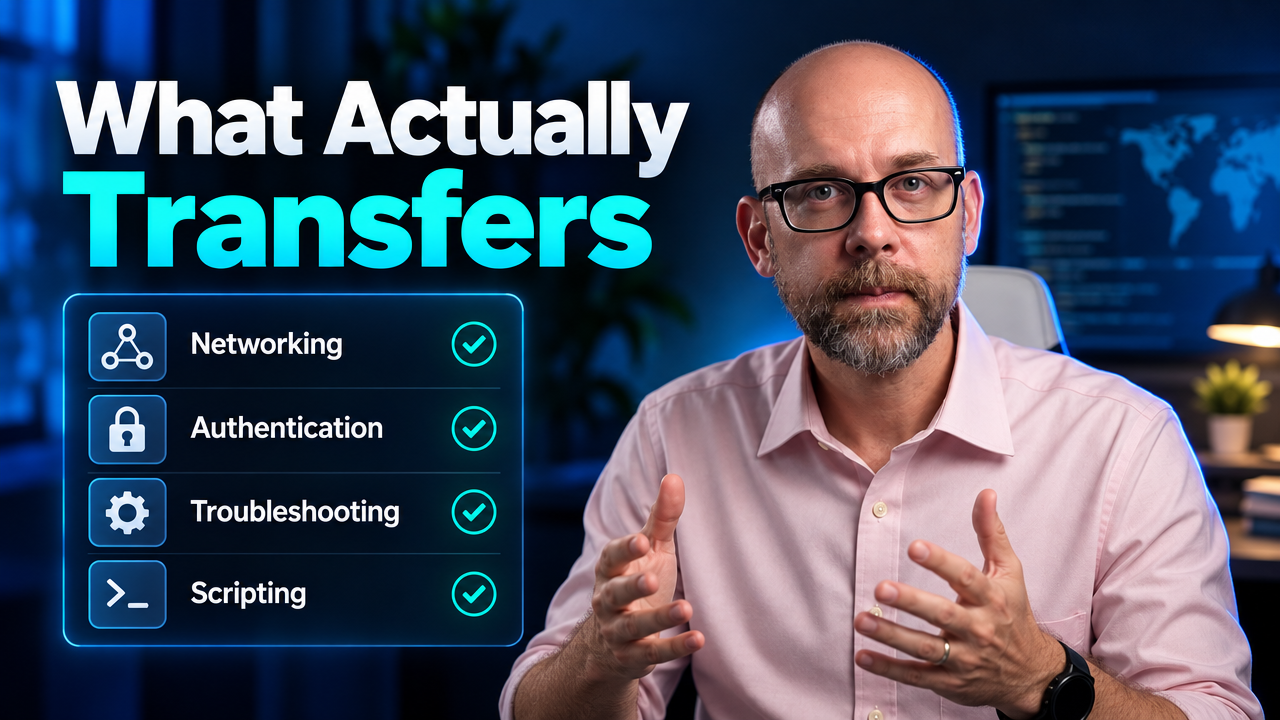
Understanding how networks function helps in cybersecurity, cloud architecture, and system administration. If you know how DNS works, how routing decisions are made, and how to troubleshoot connectivity issues, that knowledge applies whether you are securing cloud infrastructure or designing network segmentation for compliance.
Knowing how authentication and authorization work applies to identity and access management, security engineering, and governance roles. The principles do not change because you move from Active Directory to cloud IAM or from on-premises systems to SaaS applications.
Troubleshooting methodology transfers everywhere. If you know how to isolate problems, gather relevant information, test hypotheses, and document solutions, you bring value to any technical role. The tools change. The approach does not.
Scripting ability is universally useful. Whether you are automating security controls, provisioning cloud resources, or managing compliance workflows, the ability to write scripts that solve problems matters more than which specific language you use.
Understanding business requirements and working with stakeholders transfers completely. If you have spent years translating technical concepts for non-technical audiences, managing competing priorities, and delivering solutions that meet business needs, you have skills that many technically proficient people lack.
Professional judgment is harder to teach than technical tools. Knowing when to escalate, how to balance risk and usability, and how to make decisions with incomplete information comes from experience. That experience does not disappear when you change specializations.
How to Inventory Your Transferable Skills
Before you research a new specialization, create a baseline of what you already bring. This changes how you evaluate preparation requirements.
Start with technical knowledge that applies across IT disciplines. Do you understand networking fundamentals? Operating system architecture? Database concepts? Authentication mechanisms? Backup and recovery principles? These are not tied to one specialization.
List the tools and technologies you have used, but focus on the underlying concepts rather than specific products. You may have used VMware, but what you actually know is virtualization, resource allocation, and infrastructure management. That knowledge transfers to cloud computing even if the specific tools are different.
Identify professional skills that matter in any technical role. Can you write clear documentation? Communicate technical information to different audiences? Manage projects? Work effectively with cross-functional teams? These abilities are often more valuable than specific technical knowledge when hiring managers evaluate mid-level candidates.
Consider industry context you have accumulated. If you have worked in healthcare IT, you understand regulatory requirements, compliance pressures, and how technology decisions are made in that environment. That context is valuable in cybersecurity, GRC, or any other specialization within the same industry.
This inventory creates a foundation. When you research a new specialization, you can compare what you already know against what the role requires rather than assuming you are starting from zero.
Evaluating Career Moves Based on Proximity to Your Current Experience
Not all career transitions require the same preparation. Some specializations are close to your current experience. Others are significant shifts.
A network engineer moving into cloud networking needs far less preparation than moving into application security. The foundational knowledge transfers directly. You already understand routing, switching, load balancing, and network design. You need to learn how those concepts apply in cloud environments and which tools are used, but you are not learning networking from scratch.
A system administrator transitioning to cybersecurity operations has a shorter path than transitioning to software development. You already know operating systems, common vulnerabilities, logging and monitoring, and incident response basics. You need to deepen security-specific knowledge and learn specialized tools, but much of your technical foundation applies.
Someone in help desk or desktop support moving into governance, risk, and compliance can build on their understanding of how IT services are delivered, how users interact with technology, and how policies are enforced. The technical skills are less important than communication ability and understanding business processes.
Evaluate potential career moves by asking how much of your current work overlaps with the target role. Do not just compare job titles. Look at the actual knowledge and skills required and assess how much you already have versus how much you would need to develop.
Market Demand and Compensation Reality
Career transitions should be evaluated based on more than personal interest. Market demand, compensation expectations, and job availability matter.
Some specializations offer strong demand, competitive salaries, and multiple entry points. Cloud engineering, cybersecurity, and site reliability engineering currently fall into this category in most markets. The preparation effort is justified by favorable job prospects.
Other areas may require significant preparation for uncertain job availability or compensation that does not justify the investment. This does not mean you should not pursue them, but you should make the decision with realistic expectations.
Compensation during career transitions depends largely on how much of your experience transfers. If you are making a lateral move where most of your knowledge applies, you should not expect a significant pay cut. If you are moving into an area where you genuinely lack relevant experience, you may need to accept lower compensation temporarily while you build credibility.
The key is understanding which situation applies. Many IT professionals accept unnecessary pay cuts because they position themselves as beginners rather than experienced professionals redirecting their expertise.
Testing a Career Direction Before Fully Committing
You do not need to earn certifications and apply for jobs before knowing whether a career change makes sense. You can test direction and aptitude first.
Look for projects in your current role that expose you to the new area. If you are interested in cybersecurity, volunteer for security-related initiatives. Take responsibility for vulnerability management, security monitoring, or compliance reporting. This gives you practical exposure and helps you evaluate whether the work matches your expectations.
Seek cross-functional collaboration opportunities. Work with teams in your target specialization. See how they approach problems, what their daily work involves, and what skills they rely on most. This provides insight that job descriptions and certification courses do not.
Take on side responsibilities that build relevant experience. If you want to move into cloud engineering, propose migrating a workload to the cloud as a learning project. If you are interested in GRC, offer to help with audit preparation or policy documentation.
Talk to people currently working in the specialization. Ask specifically what skills from your current role would transfer and what gaps would matter most. Get practical input rather than relying on marketing materials or job postings.
This approach lets you validate interest and aptitude before making major preparation investments. You may discover that the specialization is not what you expected, or you may confirm that it is a good fit and gain relevant experience in the process.
Common Mistakes When Changing IT Specializations
The most common mistake is over-credentialing. IT professionals assume they need every certification mentioned in job postings before they can be competitive. In reality, employers hiring for mid-level roles often value transferable experience and the ability to learn over a stack of entry-level certifications.
Another mistake is underestimating how much current experience applies. Someone with five years in system administration transitioning to cloud engineering is not an entry-level cloud engineer. They are an experienced IT professional with a specific knowledge gap. Position yourself accordingly.
Choosing a career path based on hype rather than realistic self-assessment delays progress. Every few years, a different specialization becomes trendy. People pursue it without evaluating whether their skills and interests align with the actual work. Interest fades when the reality does not match expectations.
Waiting for perfect readiness prevents action. You will never know everything before making a move. The question is whether you know enough to be competitive and can learn the rest on the job or through targeted preparation.
Making the Decision
Evaluate potential career moves using what you can carry forward as the starting point. Inventory your transferable skills first. Identify actual knowledge gaps second. Then make realistic decisions about preparation time and market opportunity.
Compare multiple options rather than fixating on one path. Look at three to five potential specializations that build on your current experience. Assess them based on how much knowledge transfers, how significant the skill gaps are, what market demand looks like, and how long realistic preparation would take.
Create a preparation plan based on actual gaps rather than assumed requirements. Focus on knowledge and experience that would make you competitive, not on checking every box in job descriptions.
Remember that career transitions in IT are rarely about starting over. They are about redirecting existing knowledge and filling specific gaps. The decision should be based on practical assessment of what you bring, what you need, and what the market rewards.
If you have accumulated several years of IT experience, you have built a foundation that applies in multiple directions. The question is which direction builds on that foundation most effectively and aligns with where you want your career to go.
Start by inventorying what you already bring. Then identify two or three potential career directions and compare them honestly. Talk to people working in those areas. Test your interest through projects or responsibilities in your current role. Make preparation decisions based on real gaps, not perceived ones.
The career transition that feels like starting over is usually the one you are approaching incorrectly. Most moves in IT build on what you already know. Recognize what transfers, fill the actual gaps, and move forward with realistic expectations.
Tagged:
Enjoyed this article?
Subscribe to Professor Simon's weekly newsletter for practical insights, career guidance, and leadership lessons delivered every Friday.
A confirmation email will be sent. If you don't receive it, please check your spam or junk folder.
No spam. Unsubscribe anytime.
Prefer to Listen?
Listen to Professor Simon’s IT & Cybersecurity Podcast for practical conversations about cybersecurity careers, certifications, security leadership, and real-world lessons from the field.
Listen on Spotify