Before Disaster Strikes: Building Your First Cybersecurity Incident Response Plan
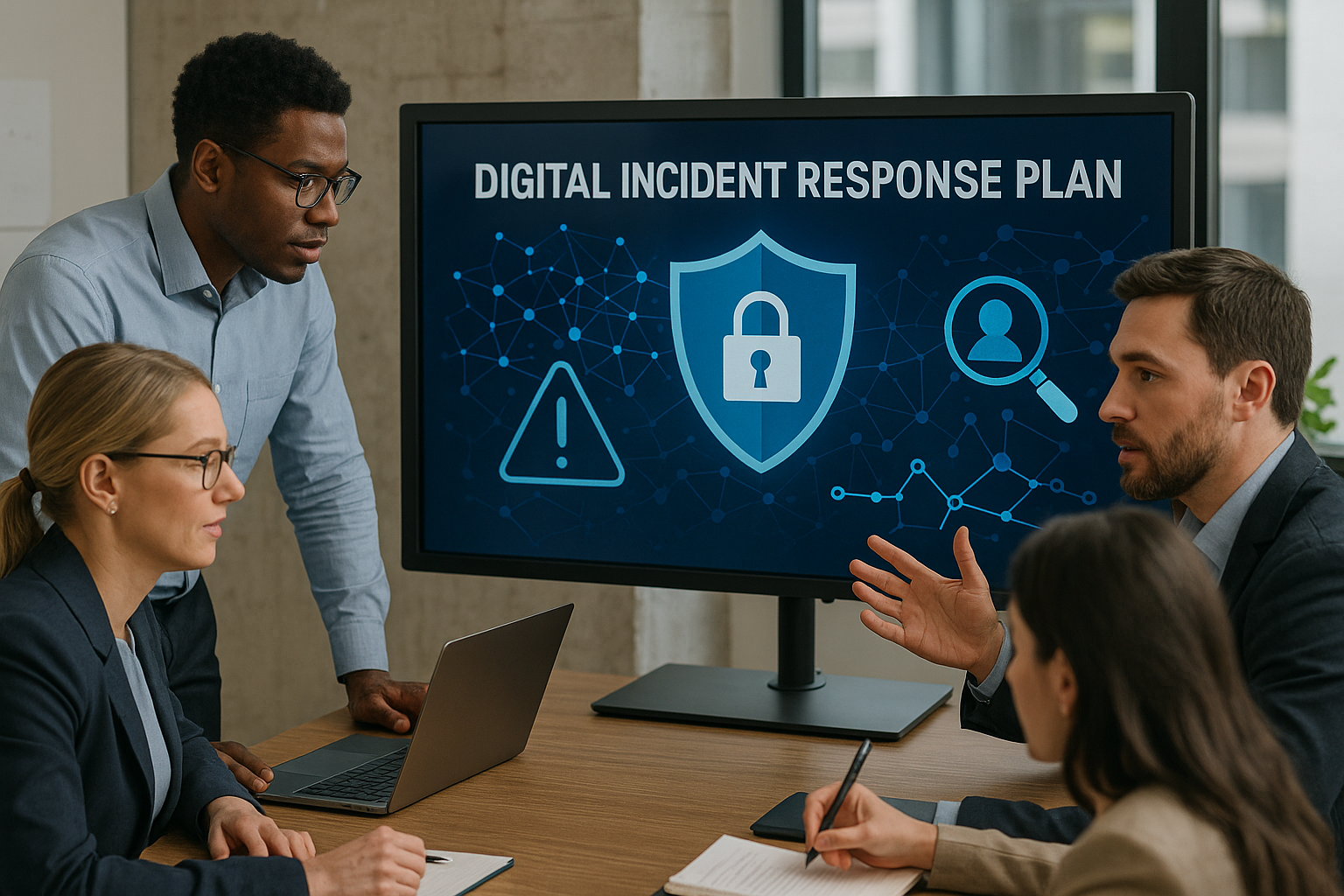
Before Disaster Strikes: Building Your First Cybersecurity Incident Response Plan
Creating an incident response plan before a security crisis hits separates organizations that recover quickly from those that spiral into chaos. Every year, companies face ransomware attacks, data breaches, and system compromises—yet many have no documented process for handling these events. The result is predictable: panicked decisions, miscommunication, and damage that could have been prevented with basic preparation.
An incident response plan provides a structured approach to managing security events. It defines roles, establishes communication channels, and outlines clear steps for containing threats. For early-career professionals and small organizations, building this plan doesn’t require enterprise-scale resources or specialized expertise. It requires clarity about what matters most and a commitment to documenting decisions before pressure eliminates good judgment.
This guide walks through creating a practical incident response plan that works for resource-constrained environments. The focus is on preparation that enables confident action during a crisis rather than perfection that never gets implemented.
Understanding What an Incident Response Plan Actually Does
An incident response plan serves as a decision-making framework during security events. When systems behave abnormally or threats are detected, people naturally experience stress that impairs judgment. The plan replaces real-time decision-making with pre-established protocols created during calm, rational moments.
The plan documents answers to critical questions that arise during incidents. Who has authority to disconnect systems from the network? Which stakeholders need immediate notification? Where are backup systems located? What external parties—law enforcement, legal counsel, forensic specialists—should be contacted? These questions demand clear answers when malware is spreading or data is being exfiltrated. A documented plan provides those answers instantly.
Organizations with formal incident response plans reduce average response time by approximately 40 percent compared to those improvising responses. This speed difference directly impacts damage severity. Hours matter when containing ransomware. Minutes matter when stopping unauthorized data access. The plan transforms incident response from reactive scrambling into systematic execution.
The Four-Phase Framework for Incident Response
NIST Special Publication 800-61 establishes a widely-adopted framework for incident response consisting of four main phases: preparation, detection and analysis, containment and eradication, and recovery. This structure provides logical progression through incident lifecycle while remaining adaptable to different organizational contexts.
Preparation forms the foundation. This phase encompasses everything done before an incident occurs—creating the response plan, assembling the team, establishing communication channels, deploying monitoring tools, and conducting training. Preparation determines response quality more than any other factor.
Detection and analysis involves identifying potential security incidents and determining their nature and scope. Not every alert indicates a genuine threat. This phase requires separating true incidents from false positives while quickly assessing severity and impact. Speed matters, but accuracy matters more. Declaring a false alarm wastes resources; missing a real incident creates vulnerability.
Containment and eradication focuses on limiting damage and removing the threat. Containment might mean isolating affected systems, disabling compromised accounts, or blocking malicious network traffic. Eradication involves eliminating the root cause—removing malware, closing vulnerabilities, or revoking unauthorized access. These activities often overlap and may occur iteratively as understanding of the incident improves.
Recovery returns systems and operations to normal functioning. This includes restoring data from backups, rebuilding compromised systems, implementing additional security controls, and monitoring for residual threats. Recovery extends beyond technical restoration to include resuming business operations and communicating with affected parties.
Building the Foundation Through Asset Identification
Effective incident response begins with knowing what needs protection. Asset identification creates an inventory of systems, data, and services that support critical operations. This inventory drives every subsequent planning decision.
Start with critical business functions. Identify which systems, applications, and data enable revenue generation, customer service, operational control, and regulatory compliance. A manufacturing company might prioritize production control systems and customer databases. A healthcare provider focuses on electronic health records and appointment scheduling systems. Understanding business priorities clarifies which assets demand fastest recovery.
Document technical dependencies. Map relationships between systems, noting which applications rely on specific databases, which services require network access, and which processes depend on third-party platforms. These dependencies become critical during incident response when isolating compromised systems might inadvertently disable unaffected but dependent services.
Classify data based on sensitivity and regulatory requirements. Financial records, personally identifiable information, intellectual property, and authentication credentials require different handling during incidents. Classification determines notification requirements, forensic procedures, and recovery priorities. Small organizations often skip this step, then discover during a breach that they cannot quickly identify what data was exposed.
Maintain this inventory in accessible format. When responding to an incident, teams need immediate access to asset information. A comprehensive spreadsheet stored on an affected system becomes useless when that system is isolated. Store asset inventories in multiple locations including offline copies or cloud services with separate authentication.
Defining Incident Categories and Severity Levels
Not all security events demand the same response intensity. Creating categories and severity ratings enables appropriate resource allocation and prevents both overreaction and underreaction.
Establish clear incident categories based on attack types and affected resources. Common categories include malware infections, unauthorized access, denial of service, data exfiltration, physical security breaches, and insider threats. Each category typically requires different response procedures. Ransomware demands immediate system isolation; potential data exposure requires forensic analysis and notification procedures.
Implement a severity rating system that considers both technical impact and business consequence. A three-tier system works well for most organizations:
Low severity incidents have minimal impact on operations and affect non-critical systems with no data exposure. Examples include isolated malware detections on non-production systems or unsuccessful intrusion attempts blocked by security controls. These incidents still require documentation and analysis but don’t justify emergency response.
Medium severity incidents affect operations or involve potential data exposure without immediate critical impact. Examples include successful phishing attacks on individual accounts, malware on systems containing business data, or unauthorized access to non-critical systems. These demand prompt response within business hours.
High severity incidents threaten critical operations, involve confirmed data breaches, or affect systems essential to business continuity. Examples include ransomware on production systems, unauthorized access to sensitive databases, or active data exfiltration. These trigger immediate response regardless of time or day.
Document specific triggers that determine severity ratings. Clarity prevents arguments during incidents. If encrypted production databases always constitute high severity regardless of current operational impact, state that explicitly. If exposure of customer contact information rates as medium but exposure of payment card data rates as high, document the distinction.
Assembling Your Incident Response Team
Effective incident response requires diverse expertise beyond technical security skills. The team must address technical threats, legal obligations, business operations, and external communications simultaneously.
Incident response coordinator leads the team and makes final decisions during incidents. This role requires broad understanding of technical, business, and legal considerations rather than deep expertise in any single area. The coordinator maintains situation awareness, ensures communication between team members, and escalates to executive leadership when necessary.
Technical security lead directs hands-on response activities including threat containment, forensic analysis, and system recovery. This person needs strong technical skills in network security, system administration, and security tools. In small organizations, this might be an IT generalist with security responsibilities. In larger environments, this role typically goes to a dedicated security operations team member.
IT operations representative manages system restoration, backup recovery, and infrastructure changes required during response. This person ensures that security measures don’t inadvertently disable business operations and coordinates the transition from containment to normal operations.
Legal counsel addresses regulatory obligations, evidence preservation, and external disclosure requirements. Security incidents often trigger legal notification requirements with specific timeframes. Legal counsel determines whether law enforcement should be contacted and manages relationships with external forensic firms if needed.
Communications lead manages internal and external messaging. During incidents, stakeholders need accurate, timely information. This role drafts notifications, coordinates with public relations, and ensures consistent messaging across channels. Poor communication often causes more reputational damage than the incident itself.
Human resources representative handles personnel aspects when incidents involve potential insider threats or when employee actions contributed to the incident. HR also manages workforce communication during significant incidents that affect daily operations.
For small organizations lacking dedicated resources in each area, identify designees from existing staff. The same person might fill multiple roles. The important element is pre-assignment with clear understanding of responsibilities. Discovering during an incident that nobody knows who should contact legal counsel wastes critical time.
Establishing Communication Protocols
Incident response demands clear, reliable communication under stressful conditions. Communication failures cause confusion, duplicate effort, and missed critical information.
Create multiple communication channels with documented fallbacks. Primary channels might include enterprise messaging platforms or video conferencing. Secondary channels should function even if primary systems are compromised—personal phone numbers, external email addresses, or messaging apps on personal devices. Test these channels before incidents occur.
Document contact information for all team members with multiple methods. Include work phone numbers, mobile numbers, personal email addresses, and physical locations. Store this information outside potentially affected systems. When primary infrastructure is compromised, responders need communication paths that function independently.
Define notification sequences that specify who contacts whom under different scenarios. Low severity incidents might trigger email notification to the technical security lead during business hours. High severity incidents might require immediate phone calls to the coordinator, technical lead, and legal counsel regardless of time. Document specific scenarios to eliminate ambiguity.
Prepare communication templates for common situations. During incidents, crafting appropriate messages from scratch consumes time and mental energy better spent on response activities. Templates ensure consistent, appropriate messaging while accelerating communication. Create templates for:
- Internal technical team notifications describing incident details and required actions
- Executive briefings summarizing situation status and business impact
- Employee notifications explaining operational disruptions
- Customer communications acknowledging incidents and describing protective actions
- Regulatory notifications meeting legal disclosure requirements
- Law enforcement reports providing necessary incident details
Establish status update cadences appropriate to severity. High severity incidents typically require hourly updates to executives and stakeholders even when situation remains unchanged. Regular updates prevent duplicate inquiries that distract responders. Medium severity incidents might warrant daily summaries. Document these expectations explicitly.
Documenting Response Procedures for Common Incidents
Generic incident response plans provide theoretical frameworks but fail during actual incidents when people need specific actions. Effective plans include detailed procedures for handling the incident types most likely to affect the organization.
Create playbooks that walk responders through each incident category step-by-step. A ransomware playbook might include:
- Initial discovery and verification steps
- Immediate containment actions including network isolation
- Evidence preservation procedures
- Backup assessment and restoration testing
- Communication sequences for internal and external notifications
- Decision criteria for whether to pay ransom
- System recovery and security hardening steps
- Post-incident monitoring requirements
Phishing incident playbooks address confirmed or suspected phishing attacks:
- User reporting procedures and intake forms
- Email analysis and indicator extraction
- Scope determination including potential victims
- Credential reset procedures for affected accounts
- Email filter updates to block similar attacks
- User notification and education
Data breach playbooks handle unauthorized data access or exfiltration:
- Incident confirmation and scope assessment
- Affected data classification and sensitivity review
- Legal notification requirement determination
- Forensic evidence preservation
- System access logging and review
- Breach notification letter preparation
- Credit monitoring or protective service offers
- Regulatory reporting procedures with specific timeframes
Document decision trees within playbooks. Responders need clear guidance on judgment calls. When should compromised systems be shut down versus isolated? Under what circumstances should law enforcement be contacted? What thresholds trigger executive notification? Decision trees based on observable criteria eliminate uncertainty.
Include tool-specific instructions within procedures. If forensic imaging requires specific software commands, document them. If log collection needs particular system queries, include exact syntax. Responders working under pressure shouldn’t need to search documentation or recall rarely-used commands from memory.
Preparing for Containment and Eradication
Containment limits incident damage by preventing spread or escalation. Eradication removes the threat from the environment. Both activities require preparation to execute effectively under pressure.
Identify containment options for different incident types with pre-authorized actions. Network segmentation boundaries should be documented with procedures for isolating segments. Administrator credentials for critical systems should be documented in secure, accessible locations. Backup communication channels should be tested and verified functional. Pre-staging these capabilities eliminates delays during actual incidents.
Document system isolation procedures that balance security with operational impact. Completely disconnecting critical systems might stop an attack but could also halt business operations or cause data loss. Alternative approaches might include:
- Disabling external network connections while maintaining internal access
- Isolating specific network segments rather than entire systems
- Blocking specific protocols or ports while allowing others
- Implementing read-only access to prevent data modification
Create criteria for choosing between isolation approaches based on incident characteristics and business requirements. These decisions shouldn’t be improvised during crises.
Maintain forensic evidence collection capabilities even in organizations without dedicated forensic teams. Basic evidence preservation might include:
- Memory capture tools that snapshot system RAM contents
- Disk imaging software that creates exact copies of storage devices
- Network traffic capture tools that record communication patterns
- Log collection scripts that gather relevant event records
Include specific instructions for evidence collection within response procedures. Forensic evidence must be handled properly to maintain legal admissibility and investigative value. Improper collection often renders evidence useless.
Establish relationships with external forensic providers before incidents occur. Many organizations lack internal capacity for complex forensic analysis. Researching and vetting providers during an incident wastes time and often results in suboptimal choices. Pre-established contracts or at minimum pre-identified providers enable rapid engagement.
Backup systems form the foundation of recovery capability. Verify that backup systems function independently from production infrastructure. Backups stored only on network drives become inaccessible if networks are compromised. Offline backups, cloud backups with separate authentication, or air-gapped backup systems provide resilience. Test backup restoration procedures regularly—untested backups often fail when needed most.
Planning Recovery and Return to Normal Operations
Recovery extends beyond restoring system functionality to include validation, enhanced security, and operational normalization. Inadequate recovery planning creates vulnerabilities that enable repeated incidents.
Define recovery objectives for each critical system. Recovery Time Objective (RTO) specifies how quickly systems must be restored. Recovery Point Objective (RPO) specifies how much data loss is acceptable. These metrics drive backup frequency and restoration procedures. A system with a four-hour RTO and one-hour RPO requires different backup architecture than a system with a 48-hour RTO and 24-hour RPO.
Document restoration sequences that account for technical dependencies. Databases must be restored before applications that depend on them. Network infrastructure must function before attempting to restore networked systems. Authentication services must operate before restoring systems that require authentication. Create ordered restoration checklists that prevent failed recovery attempts due to missing dependencies.
Include validation procedures that confirm restored systems function properly and remain free of compromise. Validation might include:
- Integrity checks comparing restored files to known-good versions
- Malware scanning of restored systems
- Configuration review ensuring security settings match baseline
- Functionality testing confirming applications operate correctly
- Network traffic analysis looking for suspicious patterns
Implement enhanced monitoring during recovery periods. Systems recently compromised require closer observation as attackers often attempt to regain access. Increased monitoring might continue for days or weeks after apparent recovery.
Plan operational communication that manages employee and customer expectations during recovery. Partial restoration rarely means full functionality. Clear communication about which services are available, what limitations exist, and when full functionality is expected prevents confusion and duplicate inquiries.
Conducting Post-Incident Reviews
Post-incident reviews convert security events into organizational learning. Organizations that skip this step repeat mistakes and miss improvement opportunities.
Schedule post-incident reviews within one week of incident resolution while details remain fresh. Delays cause memory decay and reduce participation as people shift focus to other priorities. Blocking time immediately after significant incidents signals organizational commitment to learning.
Facilitate reviews with blame-free focus on process improvement. The goal is understanding what happened and how to improve—not identifying scapegoats. People withhold information when they fear consequences. Establish ground rules that emphasize learning and discourage finger-pointing.
Structure reviews around key questions:
- What occurred and how was it detected?
- What worked well during response?
- What created difficulties or delays?
- Were roles and responsibilities clear?
- Did communication function effectively?
- Were procedures accurate and helpful?
- What information was missing that would have helped?
- What could prevent similar incidents?
- What improvements would accelerate response?
Document findings in structured format that enables action. Vague observations like “communication could improve” rarely drive change. Specific findings like “technical team couldn’t reach legal counsel for three hours because documented phone number was incorrect” identify concrete problems with obvious solutions.
Convert findings into action items with assigned ownership and deadlines. Post-incident reviews without follow-through waste time. Each improvement should have a responsible party committed to implementation and a timeframe for completion. Track action items to closure.
Update incident response plans based on review findings. Plans should evolve continuously as organizations learn from experience. Procedures that proved confusing should be clarified. Missing information should be added. Unnecessary steps should be removed. Static plans become obsolete.
Maintaining and Testing Your Plan
Incident response plans require regular maintenance and testing to remain effective. Untested plans routinely fail during actual incidents due to outdated information, unclear procedures, or lack of familiarity.
Review and update plans quarterly or after significant organizational changes. Staff turnover, system changes, new applications, and evolving threats all affect response procedures. Contact information becomes outdated as people change roles. System dependencies shift as infrastructure evolves. Threat landscapes change as attack techniques advance. Regular reviews keep plans aligned with current reality.
Conduct tabletop exercises that simulate incidents without disrupting operations. Tabletop exercises walk participants through scenarios, discussing decisions and actions at each step. These exercises identify gaps in procedures, clarify role ambiguities, and build team familiarity with the plan. Simple scenarios might include:
- An employee reports receiving a suspicious email that several colleagues also received
- Antivirus software alerts on multiple systems across the organization
- A customer reports unauthorized transactions suggesting credential compromise
- A server administrator discovers unexpected accounts with administrative privileges
More complex scenarios might combine multiple factors or introduce complications like key personnel being unavailable or communication systems being compromised.
Schedule regular tabletop exercises—quarterly for high-risk environments or semi-annually for lower-risk organizations. Vary scenarios to cover different incident types and severity levels. Include different team members to broaden experience and identify backup capability gaps.
Conduct full-scale incident response tests annually. These tests involve actual technical response activities like isolating systems, activating backup communication channels, and executing restoration procedures. Full tests reveal practical issues that tabletops miss—backup systems that fail to function as expected, procedures that take longer than anticipated, or tools that don’t work as documented.
Moving Forward with Confidence
Building an incident response plan transforms abstract security threats into manageable scenarios with clear response protocols. The plan eliminates the paralysis that accompanies unexpected crises by providing structure and direction.
Organizations often delay creating plans while pursuing perfect solutions. A basic plan implemented today provides far more protection than an ideal plan that never gets completed. Start with high-probability incidents, document essential procedures, identify team members, and establish basic communication channels. Improve iteratively based on testing and actual incident experience.
The most important element of incident response planning is commitment to preparation before incidents occur. Every documented procedure, every tested backup, every trained team member increases resilience and reduces incident impact. Organizations that invest in this preparation consistently outperform those that improvise responses during crises.
Security incidents will occur. The question is whether organizations will face them with documented plans and prepared teams or with panic and improvisation. The choice is made through preparation, not during the crisis itself.
Enjoyed this article?
Subscribe to Professor Simon's weekly newsletter for practical insights, career guidance, and leadership lessons delivered every Friday.
A confirmation email will be sent. If you don't receive it, please check your spam or junk folder.
No spam. Unsubscribe anytime.
Prefer to Listen?
Listen to Professor Simon’s IT & Cybersecurity Podcast for practical conversations about cybersecurity careers, certifications, security leadership, and real-world lessons from the field.
Listen on Spotify